Home / Blog / Getting around
Last week of term, first holiday weekend: what Singapore roads, buses and MRT showed, 16 to 22 November
The school holidays started on Saturday 21 November, so the week of 16 to 22 November is half and half: five days at the end of term, then the first holiday weekend. In our 14 November post we recorded what a normal term week looked like and said we would compare it with the holidays. This is a first look, and a short one, because the holiday weekdays have not happened yet. What we can say is how the last week of term compared with that baseline, and whether the first holiday weekend was any different from an ordinary weekend. Everything here comes from our own records of public data: Land Transport Authority travel times, bus loads, platform crowd levels and road incident alerts, plus lightning strikes. They are our records, not official statistics. All times are Singapore time.
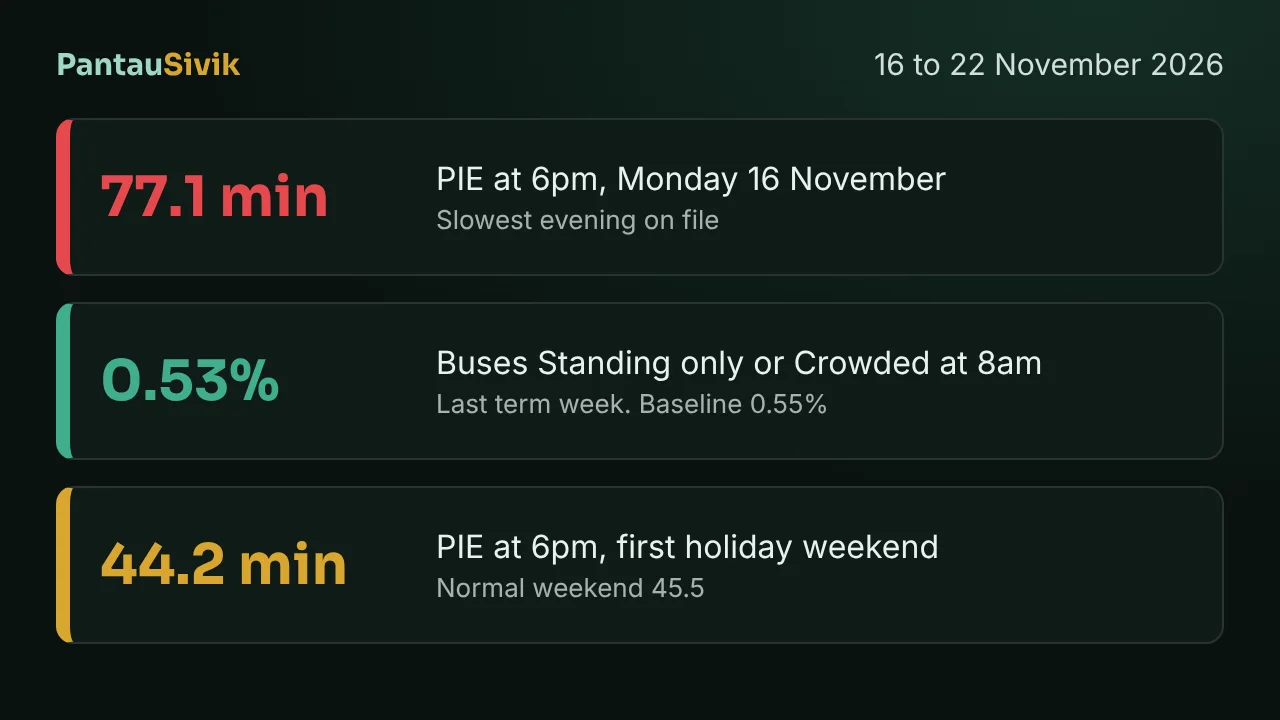
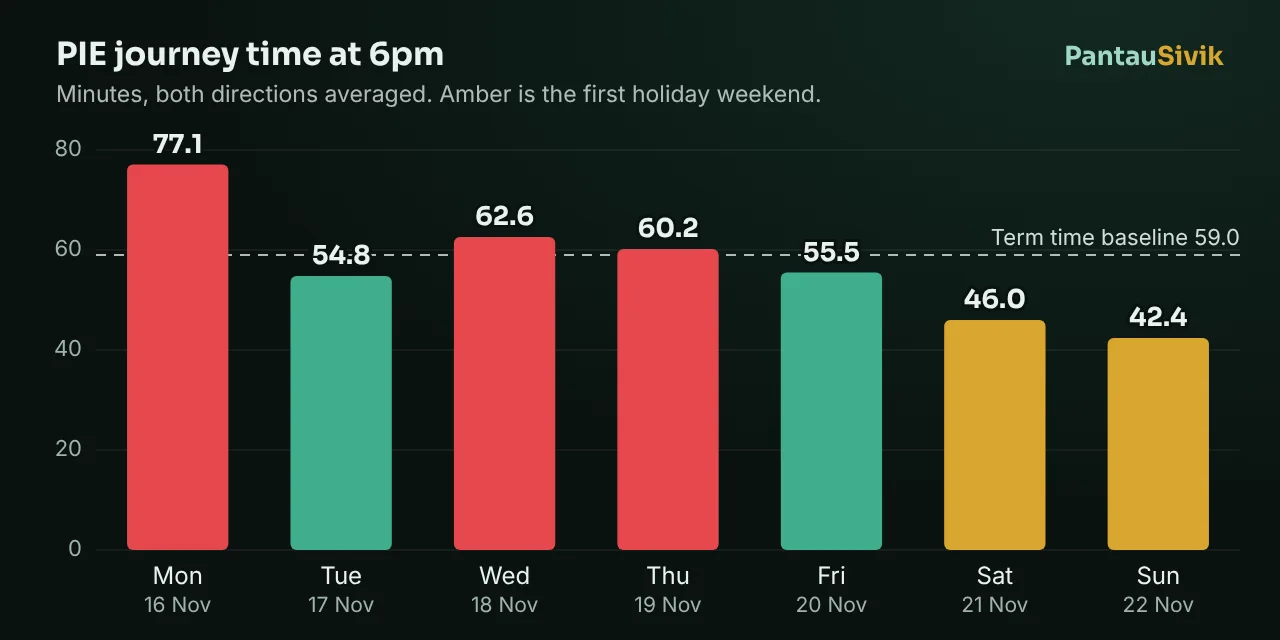
In short: the PIE at 6pm took 77.1 minutes on Monday 16 November, the slowest evening on file, on a day with 24,527 lightning strikes. The other four term weekdays averaged 58.3 minutes, in line with the 59.0 baseline, and buses and MRT platforms looked the same as before. The first holiday weekend looked like any other weekend: the PIE at 6pm took 44.2 minutes, against 45.5 on six ordinary weekend days.
Monday 16 November: the slowest PIE evening yet
For each expressway we add up the LTA journey time estimates for every stretch and average the two directions. On the PIE at 6pm, that came to 77.1 minutes on Monday. The previous slowest evening on file was Thursday 5 November, at about 74. The slowest single reading was 81.5 minutes, at 6:34pm. The quietest hour on the PIE takes about 38.5 minutes, so Monday evening took about twice as long.
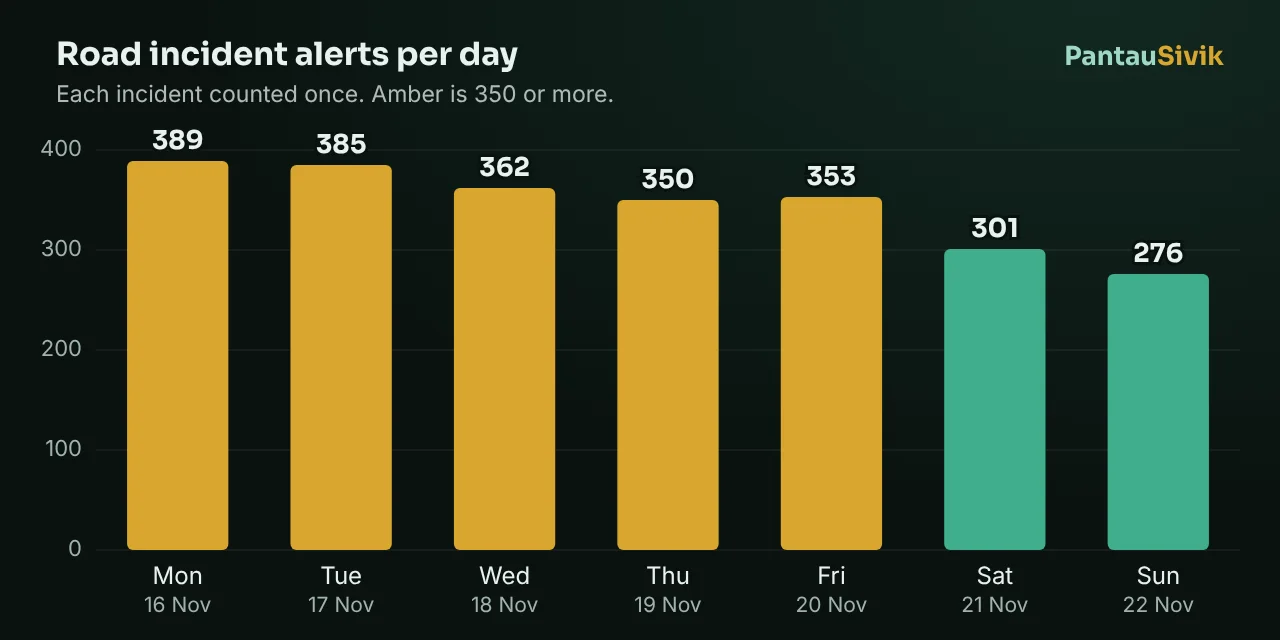
It was a busy and stormy day. We logged 389 road incident alerts, the most of the week, including 73 for heavy traffic. Between 3pm and 8pm, 45 alerts mentioned the PIE, and 22 of those were breakdowns. A thunderstorm crossed Singapore in the late afternoon: 24,527 lightning strikes were logged on the day, 24,284 of them between 4pm and 7pm, and 14,859 in the hour from 5pm. We cannot say how much of the delay came from the storm, the breakdowns or an ordinary Monday rush hour.
Storms do not always slow the PIE. On Wednesday 18 November there were 25,262 strikes, mostly between 1pm and 5pm, and the PIE at 6pm took 62.6 minutes. On Sunday 22 November there were 24,224 strikes, most of them between 4pm and 6pm, and the PIE at 6pm took 42.4 minutes, the fastest of the week. A storm on a weekend evening meets far fewer cars.
The other four weekdays matched the baseline
Tuesday to Friday, the PIE at 6pm took 54.8, 62.6, 60.2 and 55.5 minutes. That averages 58.3, against 59.0 in the 14 November baseline. Friday 20 November, the last day of term, started faster than usual: 45.2 minutes on the PIE at 8am, against 50.5 on a typical term weekday. That evening 5pm was slower than 6pm, at 62.2 minutes against 55.5.
Across all five term days the other expressways were close to the baseline, with one exception. Average minutes at 6pm, last week against the baseline:
- AYE: 35.2 against 33.5
- TPE: 20.6 against 17.6
- BKE: 15.0 against 14.8
- CTE: 21.0 against 19.9
- SLE: 17.1 against 16.7
The TPE ran about three minutes slower, and slower at 8am too, at 19.0 against 17.9. We do not know why. You can look at any expressway by hour on History: expressway travel times.
Incident alerts were a little higher than the week before. The five term days had 389, 385, 362, 350 and 353 alerts, against 329 to 375 on Tuesday to Friday of 9 to 15 November. Tuesday 17 November stood out for accidents: 80 alerts, against a peak of 65 in the earlier week. Of those, 15 named the PIE, 14 the AYE, 12 the TPE and 9 the SLE. Yet the PIE at 6pm on Tuesday was one of the quicker evenings, at 54.8 minutes. Roadworks led the week with 967 of 2,416 alerts, ahead of breakdowns with 808, accidents with 304 and heavy traffic with 271.
Buses and MRT: the same shape as before
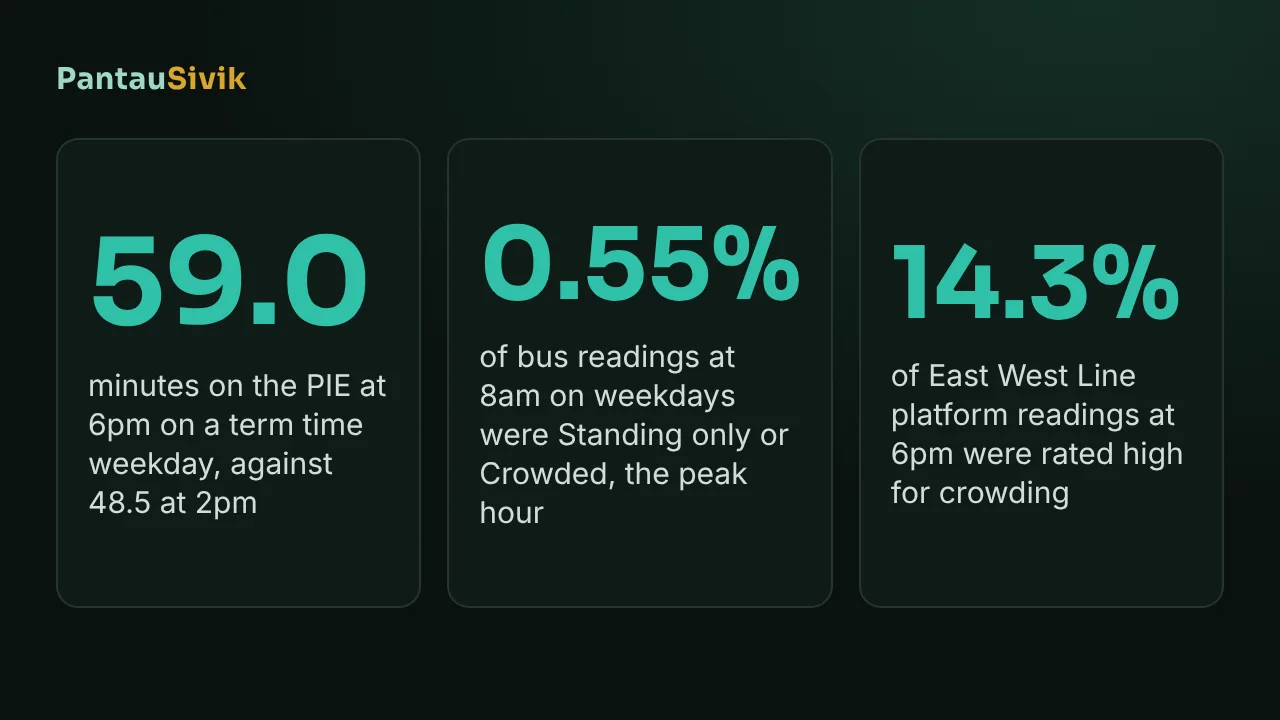
At the 32 bus interchanges we monitor, the share of readings that were Standing only or Crowded on weekdays was 0.53% at 8am (0.55% in the baseline), 0.42% at 7am (0.48%) and 0.45% at 6pm (0.44%). Mid afternoon stayed quiet, at 0.10% at 3pm. The morning and evening peaks sit where they did, and they are about the same size. Our interchange ranking shows which ones account for most of them.
On MRT platforms, 19 of 131 East West Line readings at 6pm were rated high for crowding (14.5%, against 14.3% in the baseline), and 13 of 104 on the North South Line (12.5%, against 11.9%). These are small samples, but they point the same way: nothing changed in the last week of term.
The first holiday weekend looked like any weekend
To see whether the holidays had changed anything yet, we set Saturday 21 and Sunday 22 November against six ordinary weekend days: 24 and 25 October, 31 October and 1 November, and 14 and 15 November. We left out the Deepavali weekend of 7 and 8 November. On the roads they were almost identical:
- PIE at 6pm: 44.2 minutes, against 45.5. At 8am, 41.6 minutes in both.
- AYE at 6pm: 28.2 against 28.4. TPE: 14.1 against 14.5.
- Incident alerts: 301 on Saturday and 276 on Sunday, inside the 254 to 331 range of the six earlier days. Sunday had 165 roadworks alerts, between the 130 and 202 of three earlier Sundays.
Buses were a little quieter at midday and in the evening. The share of readings that were Standing only or Crowded was 0.28% at 1pm, against 0.39%, and 0.32% at 6pm, against 0.36%. Weekend platforms rarely show high crowding at 6pm: there were none in 34 readings on the East West and North South lines. That is too few readings to say more.
What comes next
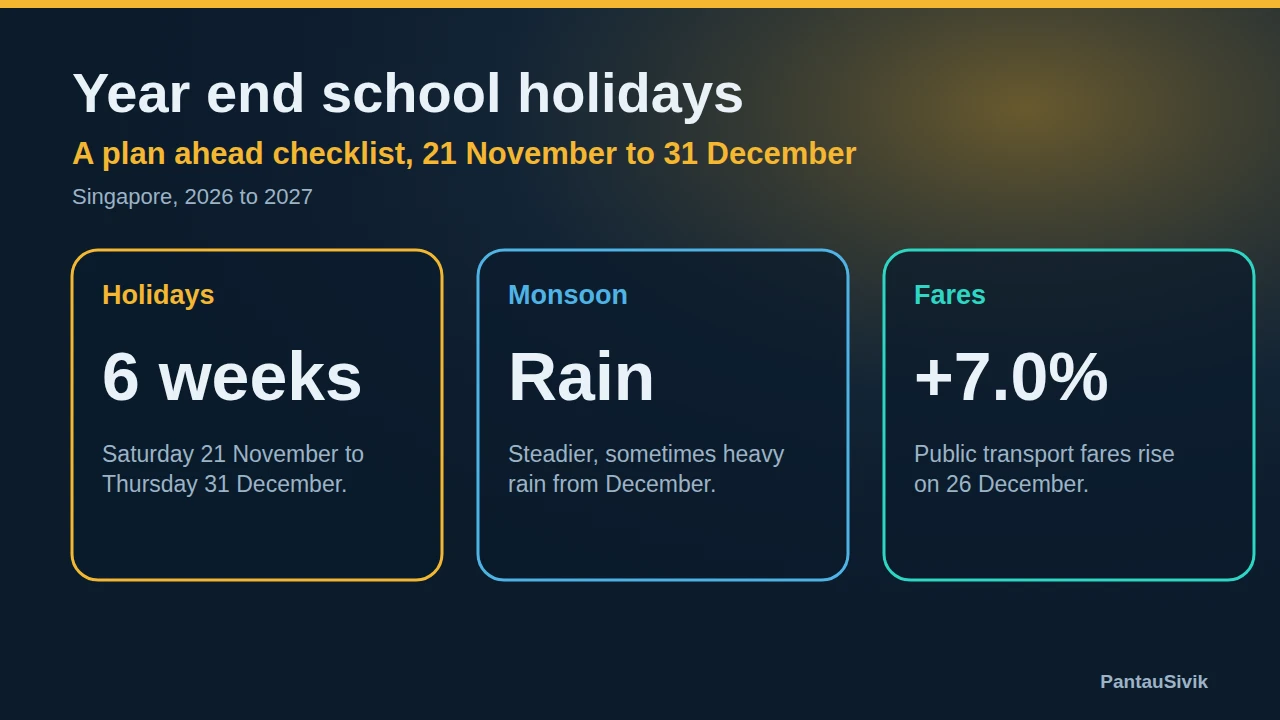
The real test is the weekdays. MOE schools are on holiday from 21 November, but junior colleges and Millennia Institute only break from Saturday 28 November, so 23 to 27 November is a mixed week. The first week when every school is out starts on Monday 30 November. We will compare the holiday weekdays with the baseline numbers, the PIE at 6pm on weekdays (59.0 minutes), the bus share at 8am (0.55%) and the East West Line at 6pm (14.3% rated high), in early December, as planned. Until then, our year end school holidays checklist covers what to plan, and History: platform crowding and History: bus crowding update every week.
What this does not tell you
- This is one week. Monday's record is a single evening, and a storm, breakdowns and rush hour all landed in it together.
- Only two days of the holidays are in this post. Six ordinary weekend days is a small reference, and weekends vary from one to the next.
- Incident alerts count notices, not crashes. We count each incident once a day, so one that runs past midnight can appear on two days.
- Travel times are LTA estimates for the stretches it reports. We average the readings in each hour and both directions.
- Bus figures are shares of readings at 32 interchanges, not counts of passengers. Platform readings are few for most lines and hours.
- Lightning counts are strikes that PantauSivik logged. Matching a storm with a slow road does not show that one caused the other.
Common questions
How long did the PIE take at 6pm on Monday 16 November 2026?
In PantauSivik records, adding up Land Transport Authority estimates for each stretch and averaging both directions, the PIE took 77.1 minutes at 6pm. That is the slowest evening on file. The slowest single reading was 81.5 minutes at 6:34pm.
Did Singapore roads get quieter when the school holidays began?
Not on the first weekend. On Saturday 21 and Sunday 22 November the PIE at 6pm averaged 44.2 minutes, against 45.5 on six ordinary weekend days. We will compare the holiday weekdays with our term time baseline in early December.
When are the 2026 year end school holidays in Singapore?
MOE schools are on vacation from Saturday 21 November to Thursday 31 December 2026. Junior colleges and Millennia Institute go from Saturday 28 November to Thursday 31 December.
Which day had the most road incident alerts from 16 to 22 November?
Monday 16 November, with 389 alerts. The quietest day was Sunday 22 November, with 276. PantauSivik logged 2,416 road incident alerts over the week, counting each incident once a day.
Were buses and MRT more crowded in the last week of term?
No. At the bus interchanges PantauSivik watches, 0.53% of weekday readings at 8am were Standing only or Crowded, against 0.55% in the baseline. East West Line platforms were rated high in 14.5% of 6pm readings, against 14.3%.
Sources: PantauSivik's own records of public data, 16 to 22 November 2026, in Singapore time, compared with 19 October to 13 November and with six ordinary weekend days. Expressway times, bus loads and platform crowd levels use Land Transport Authority data. Incident alerts are counted once per incident per day. School dates are from the Ministry of Education, as given in our 14 November post. Charts on the History pages update weekly.
Information in PantauSivik comes from public sources and is there to help you plan. In an emergency, follow official channels. PantauSivik is independent and not affiliated with any government agency.
See also: Term time baseline for roads, buses and MRT, Roads week in data, 9 to 15 November, Expressway travel times by hour, History overview.