Home / Blog / Getting around
Which bus interchanges get crowded? 8 of 32 account for 99% of full buses
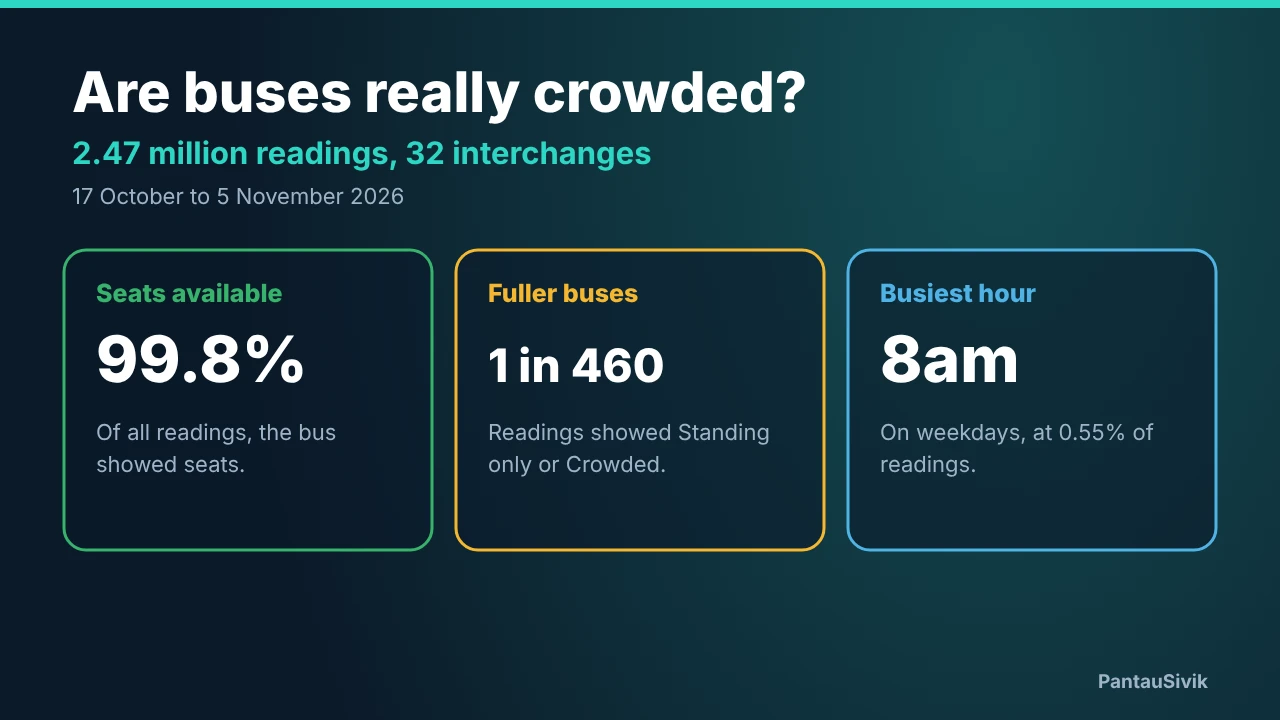
Our earlier post, Are buses really crowded?, found that buses at 32 interchanges almost always showed seats. That is true on average. This post asks where the exceptions are. We now have 28 days of readings, from Saturday 17 October to Friday 13 November, and we split them by interchange. The answer is that nearly all of the full buses came from a handful of places.
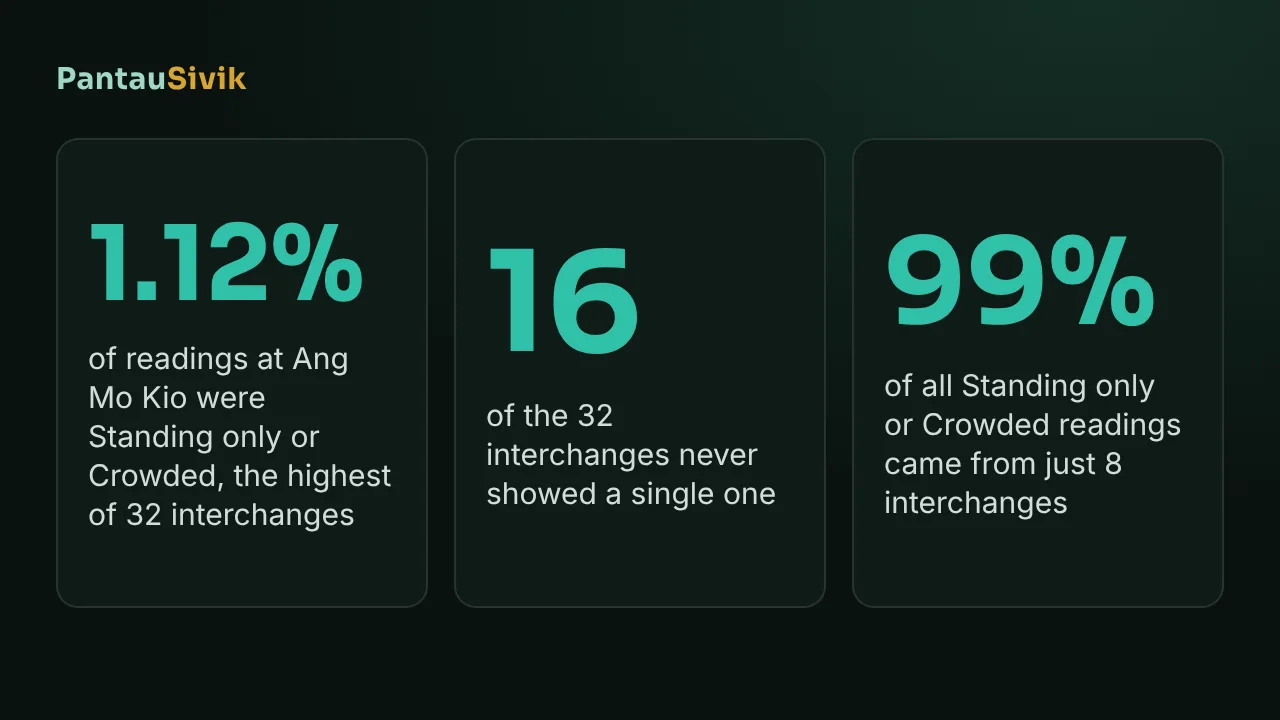
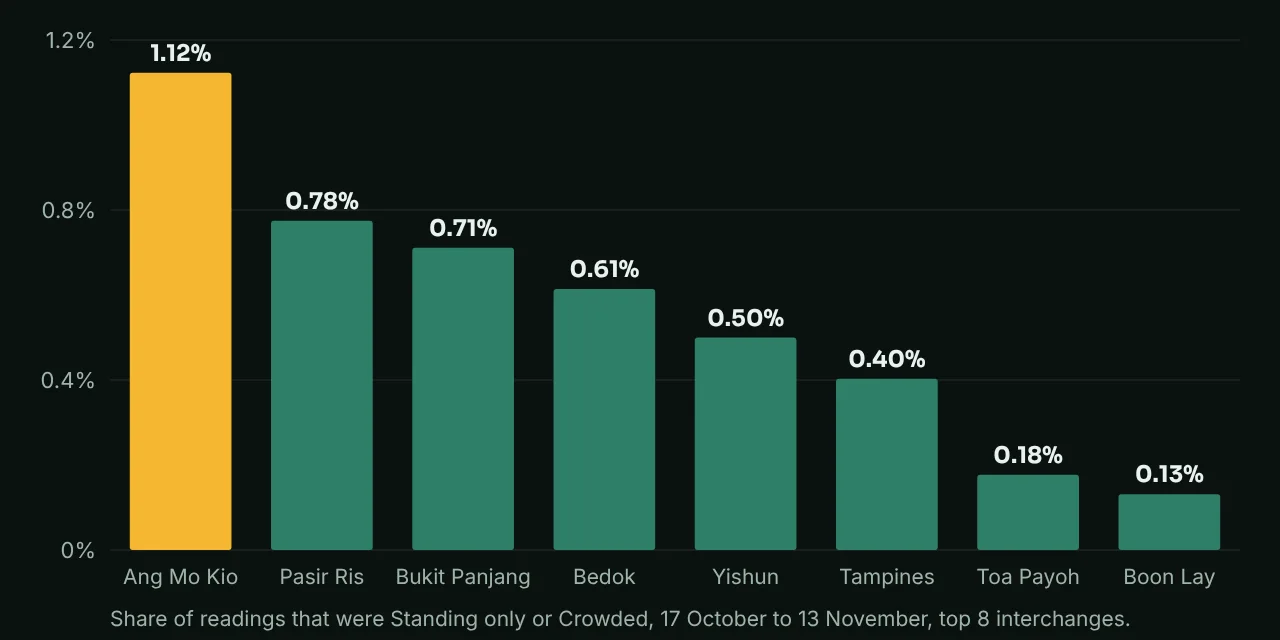
In short: of 3,496,296 readings, 7,351 showed Standing only or Crowded, 0.21%, or about 1 in 476. Eight of the 32 interchanges account for 7,297 of them, 99%. Ang Mo Kio was highest at 1.12%, then Pasir Ris (0.78%), Bukit Panjang (0.71%) and Bedok (0.61%). 16 interchanges never showed a single one. The busy hour is different at each: lunchtime at Ang Mo Kio, 8am at Pasir Ris and 6pm at Bukit Panjang.
How we counted
Every few minutes the app records, for each of 32 monitored bus interchanges, the load level shown for each bus in its arrival list: Seats available, Standing only or Crowded. We added those up by interchange, and matched each interchange to its name from the bus stop code. The same bus can appear in many readings as it comes closer, so these are readings, not separate buses or passengers. The share is the readings that were Standing only or Crowded divided by all readings at that interchange. All times are Singapore time.
The ranking
Here are the eight interchanges where we saw any meaningful share, with the number of Standing only or Crowded readings out of all readings.
- Ang Mo Kio: 1.12% (1,621 of 144,314)
- Pasir Ris: 0.78% (1,073 of 138,369)
- Bukit Panjang: 0.71% (713 of 100,280)
- Bedok: 0.61% (1,394 of 226,962)
- Yishun: 0.50% (1,009 of 201,887)
- Tampines: 0.40% (866 of 214,744)
- Toa Payoh: 0.18% (326 of 184,277)
- Boon Lay: 0.13% (295 of 224,511)
The other 24 are close to zero. Sengkang (14 of 60,131), Clementi (23 of 122,314), Bukit Batok (5), Joo Koon (3), Serangoon (3), Choa Chu Kang (3), Punggol (2) and Hougang Central (1) each had a few. The remaining 16 never showed one, including Woodlands, which had 204,211 readings, and Jurong East, Bishan, HarbourFront, Bukit Merah and Sembawang.
Each interchange has its own busy hour
The citywide pattern of a weekday morning peak at 8am (0.5%) comes from adding these together. At the interchanges themselves it looks different. We only counted hours with at least 400 readings.
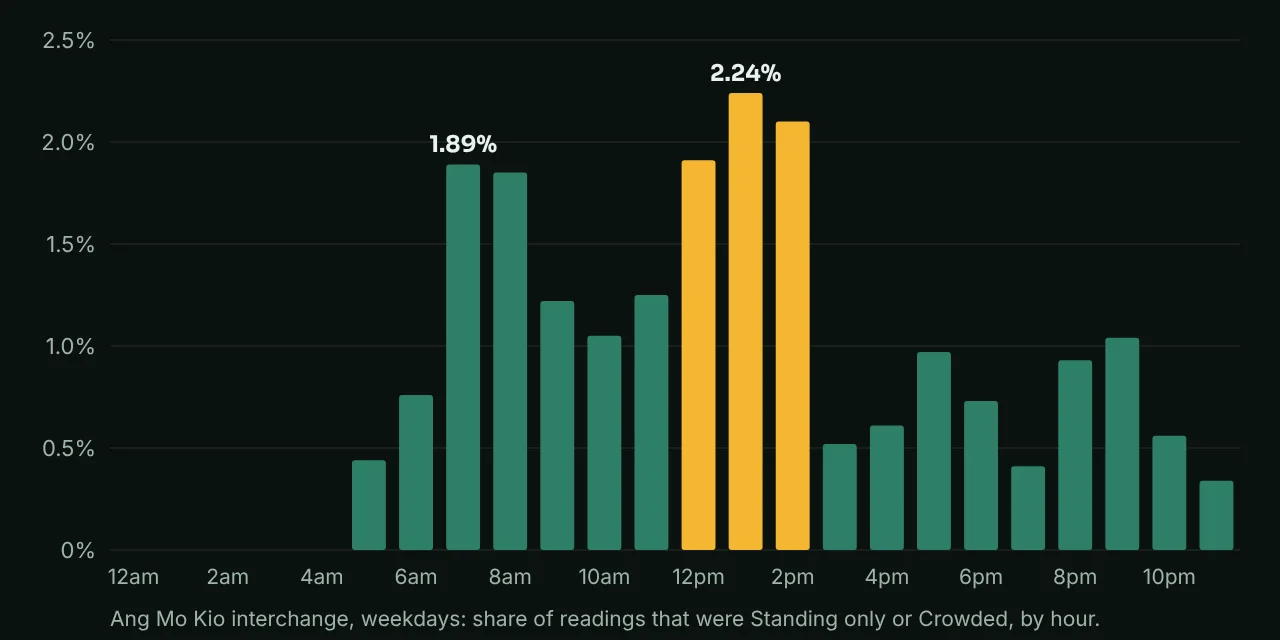
- Ang Mo Kio peaks around lunch on weekdays: 2.24% at 1pm, 2.10% at 2pm and 1.91% at 12pm. The morning is high too, at 1.89% at 7am. On weekends it peaks at 11am with 2.23%.
- Pasir Ris is a morning interchange on weekdays: 3.18% at 8am and 2.90% at 7am, the highest hourly share we saw anywhere, apart from Bukit Panjang. At weekends it is flatter, with a peak of 1.62% at 1pm.
- Bukit Panjang peaks in the evening: 3.27% at 6pm and 2.42% at 5pm on weekdays. At weekends its highest is 0.86%, so it is largely a commuter pattern.
- Bedok and Yishun peak at 6pm on weekdays, at 1.50% and 1.41%. Yishun is busiest at 11am on weekends, at 1.54%.
- Tampines and Toa Payoh peak at 8am on weekdays, at 1.36% and 1.28%.
Only 35 readings were Crowded
Almost all of the 7,351 were Standing only. Only 35 readings were Crowded, about 1 in 100,000. Boon Lay had 18 of them, even though its overall share is just 0.13%. Its busiest hour is 6pm on weekdays, at 0.92%. Ang Mo Kio had 6, Yishun 4, Bukit Panjang 3, Tampines 3 and Joo Koon 1.
A holiday shows the commuter effect
Monday 9 November, the Deepavali holiday, had the lowest share of any day on file: 0.11% (135 of 126,090), against 0.18% to 0.25% on other days. The weekday rush was missing. It fits the pattern at Pasir Ris and Bukit Panjang, where the peaks are on workday mornings and evenings.
What it means for you
- At most of these interchanges you can expect seats on the next bus, even at the busiest hour. The eight above are where a fuller bus is most likely.
- At Ang Mo Kio, check the load at lunchtime as well as the morning. At Pasir Ris, check on weekday mornings, and at Bukit Panjang on weekday evenings.
- If the first bus shows Standing only and the next one shows Seats available, our Bus arrival times guide shows where to find the load for each bus in the list.
What this does not tell you
- These are interchanges, where many services start or end. A bus about to start a trip will usually show seats, and buses tend to fill up on the road. So these numbers probably understate how full buses get mid route.
- It does not say which services are fullest. We count readings by interchange, not by service.
- Some interchanges have fewer readings, so small differences between them, such as Toa Payoh and Boon Lay, may not mean much.
- The hours shown are from 28 days. They may change with school terms, holidays or new routes.
- We matched each interchange to its name using the bus stop code and have not confirmed the name of one of the 32, which had no Standing only or Crowded readings.
Common questions
Which Singapore bus interchanges get the most crowded buses?
In PantauSivik readings from 17 October to 13 November 2026, Ang Mo Kio had the highest share of buses showing Standing only or Crowded, at 1.12%. Pasir Ris (0.78%), Bukit Panjang (0.71%) and Bedok (0.61%) followed.
When are buses fullest at Ang Mo Kio, Pasir Ris and Bukit Panjang?
Ang Mo Kio peaks around lunch on weekdays, at 2.24% at 1pm. Pasir Ris peaks at 8am on weekdays, at 3.18%. Bukit Panjang peaks at 6pm on weekdays, at 3.27%.
How rare is a full bus at a Singapore interchange?
Very rare. Only 35 of 3,496,296 readings showed Crowded, about 1 in 100,000. Across the 32 interchanges, about 0.21% showed Standing only or Crowded, about 1 in 476.
Which interchanges never showed a crowded bus?
Sixteen of the 32 never showed Standing only or Crowded, including Woodlands, Jurong East, Bishan, HarbourFront, Bukit Merah and Sembawang.
What does Standing only mean on a bus arrival?
It is the second of three load levels the Land Transport Authority reports for an arriving bus. Seats available means there are seats, Standing only means the seats are taken but there is room to stand, and Crowded means the bus is full.
Sources: PantauSivik's own bus load readings for 32 bus interchanges, 17 October to 13 November 2026, in Singapore time. Load levels come from the Land Transport Authority DataMall, and interchange names are matched from the bus stop code. Charts are also on the History bus crowding page.
Information in PantauSivik comes from public sources and is there to help you plan. In an emergency, follow official channels. PantauSivik is independent and not affiliated with any government agency.
See also: Are buses really crowded?, Week in data, 6 to 12 November, History: bus crowding, Bus arrival times guide, Check MRT and LRT crowds before you leave.