Home / Blog / Getting around
Expressway travel times in Singapore by hour: when the PIE, TPE and BKE slow down
How long does an expressway trip take, and does it matter when you leave? PantauSivik records the estimated travel time for each stretch of eight expressways about every 15 minutes, from LTA data, and we now have 18 days of it, from Saturday 17 October to Tuesday 3 November 2026. This post adds the stretches up to see how each road changes through the day, which roads slow down most, and how different a weekend is. We first published it on 29 October with 12 days and have now updated every number.
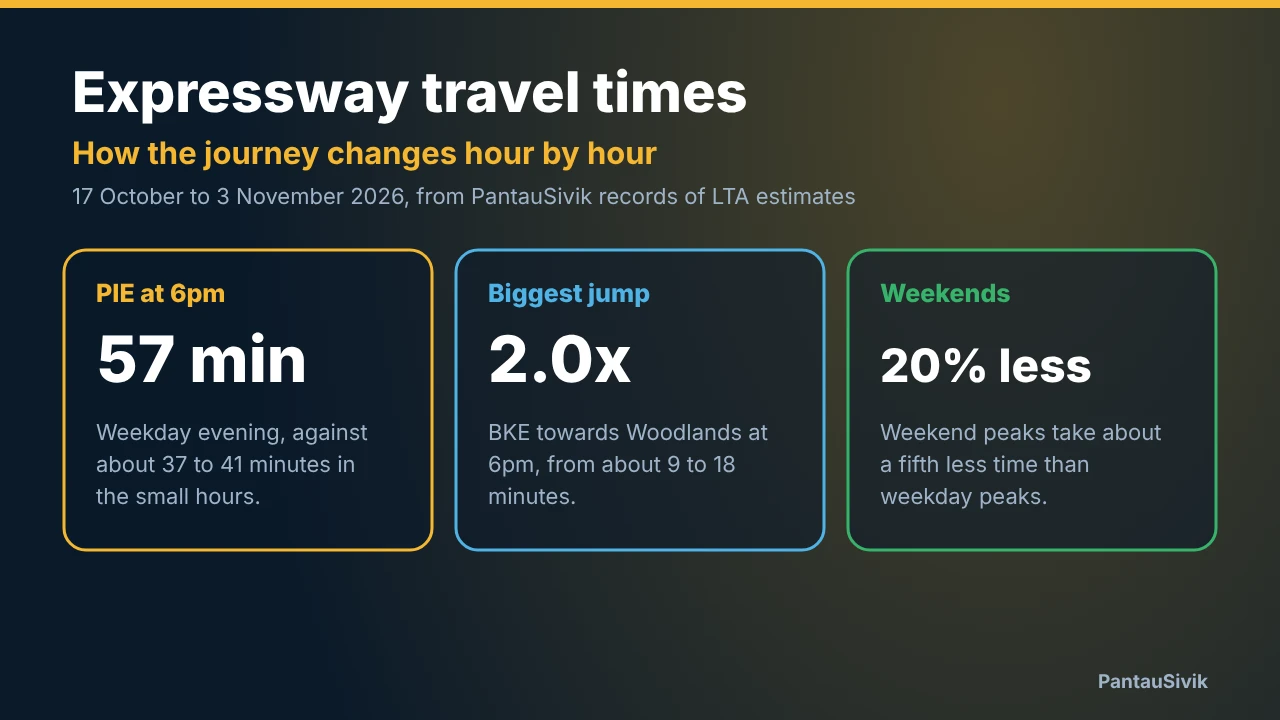
In short: the PIE is the slowest road in minutes, at about 57 minutes at 6pm on weekdays against about 37 to 41 in the small hours. In proportion, the biggest slowdowns were the BKE towards Woodlands at 6pm (2.0 times its quiet time), the TPE towards the PIE at 8am (1.8 times) and the SLE (about 1.6 times). Weekends were calmer: across all 16 road and direction combinations, the busiest weekend hour was on average about 20% shorter than the busiest weekday hour. These are LTA estimates added together, not timed drives.
What we measured
LTA publishes an estimated travel time for each stretch of an expressway, from one named point to the next, such as from one interchange to a junction. Our records hold 16 road and direction combinations: eight expressways, two directions each. Together that is 192 stretches. We took 1,642 snapshots, about one every 15 minutes, and in every snapshot all 192 stretches were present. For each snapshot we added up the stretches of one road and direction to get one number, in minutes. All times are Singapore time. There were 12 weekdays and 6 weekend days, and no public holidays.
Two things to keep in mind. First, each stretch is given in whole minutes, so short stretches are rounded, and the sums are estimates. Second, the sum covers the whole stretch LTA reports, not your trip. Most trips use only part of a road. Roads are also different lengths, so compare how much each one changes, not how many minutes it takes in total.
| Road | LTA stretch used (direction 1 and 2 run opposite ways) |
|---|---|
| PIE | PIE/ECP interchange to PIE/AYE interchange |
| AYE | AYE/MCE interchange to Tuas Checkpoint |
| CTE | AYE/CTE interchange to SLE/CTE interchange |
| TPE | PIE/TPE interchange to SLE/CTE/TPE interchange |
| ECP | Changi Airport to Rochor Road |
| BKE | BKE/PIE interchange to Woodlands Centre |
| SLE | CTE/SLE interchange to BKE/SLE interchange |
| KJE | BKE/KJE interchange to KJE/PIE interchange |
We worked out the direction of each stretch from the start and end points LTA gives for each one. The MCE and KPE are not in this set of data.
The PIE, hour by hour
The PIE is the longest road in the data, so it shows the biggest swing in minutes. In the small hours the whole stretch took about 37 minutes towards Tuas and about 41 towards Changi. On weekdays it climbed from around 6am, eased a little in the late morning, then peaked at 6pm, at about 57 minutes in both directions. That is roughly 19 and 17 minutes more than at night.
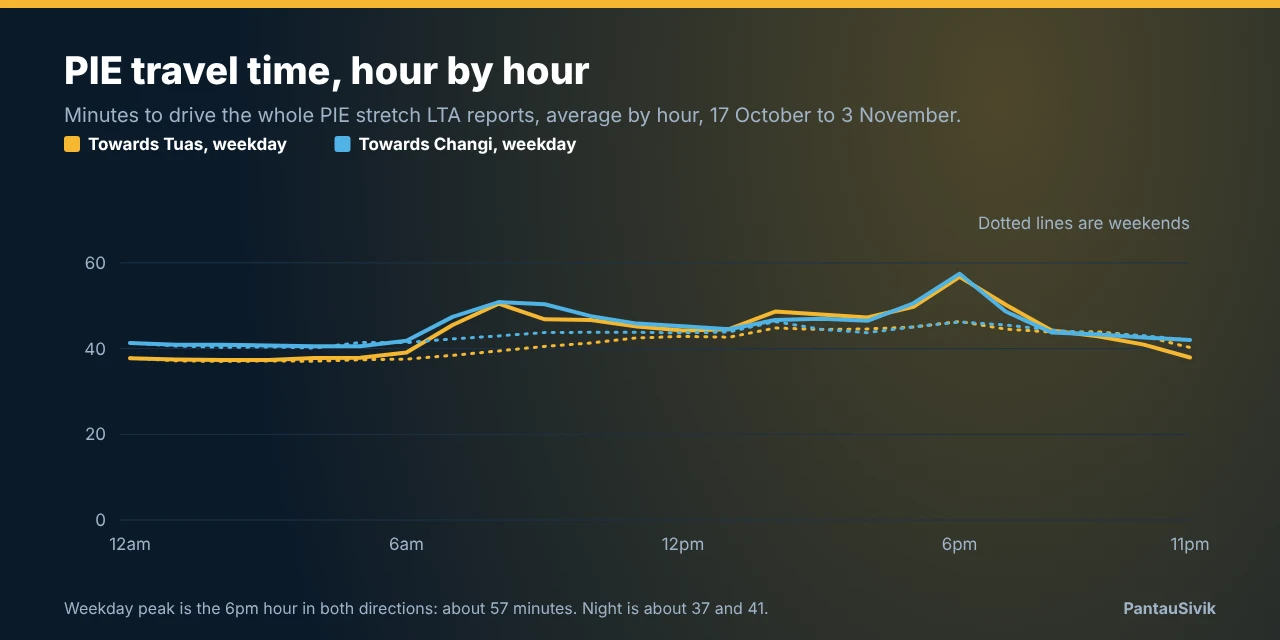
Weekends looked different. There was no sharp peak, only a slow rise through the day to about 46 minutes in the afternoon or early evening, which is about 10 to 11 minutes below the weekday peak.
Which roads slow down the most
To compare roads of different lengths, we divided each road's busiest weekday hour by its own small-hours time. The BKE towards Woodlands came out on top. It took about 9 minutes at night and 18 at 6pm, twice as long. The TPE towards the PIE was next at 1.8 times, at 8am, going from about 12 minutes to about 22. The SLE was about 1.6 times in both directions, towards the CTE at 8am and towards the BKE at 6pm.
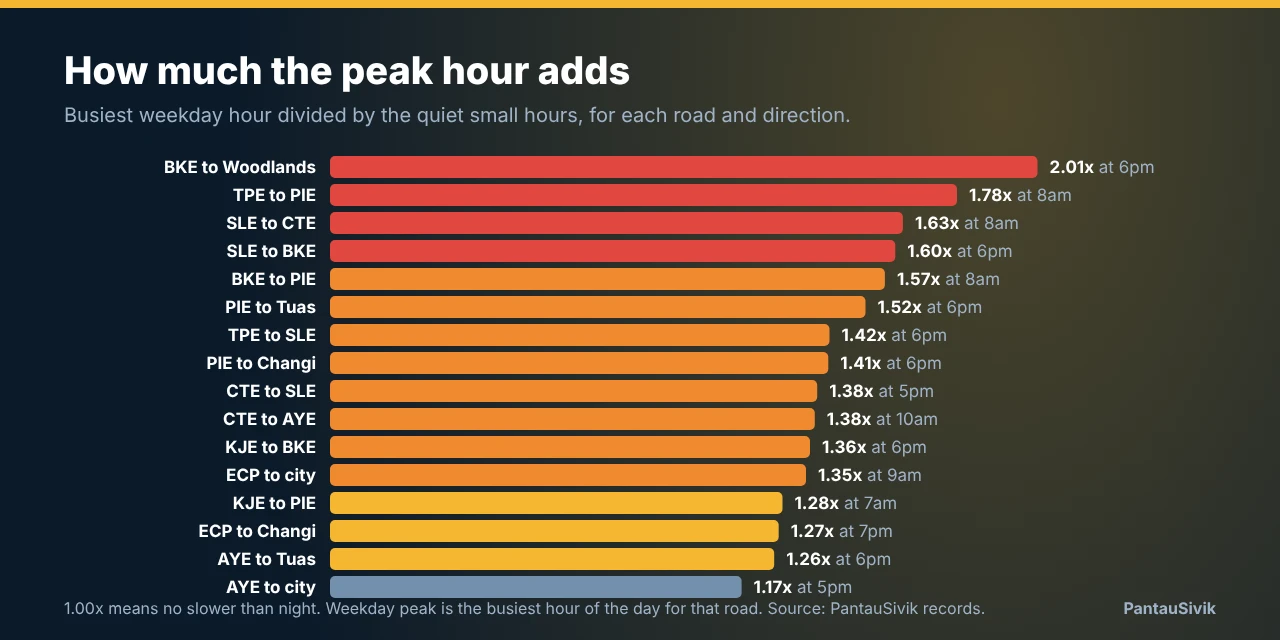
The AYE was the most steady. It is a long road, about 27 minutes at night, but it added only 17 to 26% at peak. The KJE and ECP also stayed below about 1.4 times. The table has the actual minutes.
| Road and direction | Night | 8am | 6pm | Wknd |
|---|---|---|---|---|
| PIE towards Tuas | 37 | 50 | 57 | 46 |
| PIE towards Changi | 41 | 51 | 57 | 46 |
| AYE towards Tuas | 27 | 32 | 34 | 30 |
| AYE towards the city | 27 | 29 | 31 | 28 |
| CTE towards SLE | 15 | 15 | 20 | 17 |
| CTE towards AYE | 16 | 20 | 19 | 20 |
| TPE towards SLE | 14 | 15 | 20 | 15 |
| TPE towards PIE | 12 | 22 | 14 | 15 |
| ECP towards the city | 14 | 18 | 18 | 16 |
| ECP towards Changi | 15 | 16 | 19 | 17 |
| BKE towards Woodlands | 9 | 10 | 18 | 11 |
| BKE towards PIE | 10 | 15 | 10 | 10 |
| SLE towards BKE | 11 | 16 | 17 | 13 |
| SLE towards CTE | 10 | 17 | 16 | 12 |
| KJE towards PIE | 8 | 9 | 8 | 8 |
| KJE towards BKE | 8 | 9 | 10 | 9 |
Minutes for the whole LTA stretch, averaged over the hour. Night is 1am to 5am. The 8am and 6pm columns are weekdays. Wknd is the busiest hour on Saturdays and Sundays.
When each road is slow
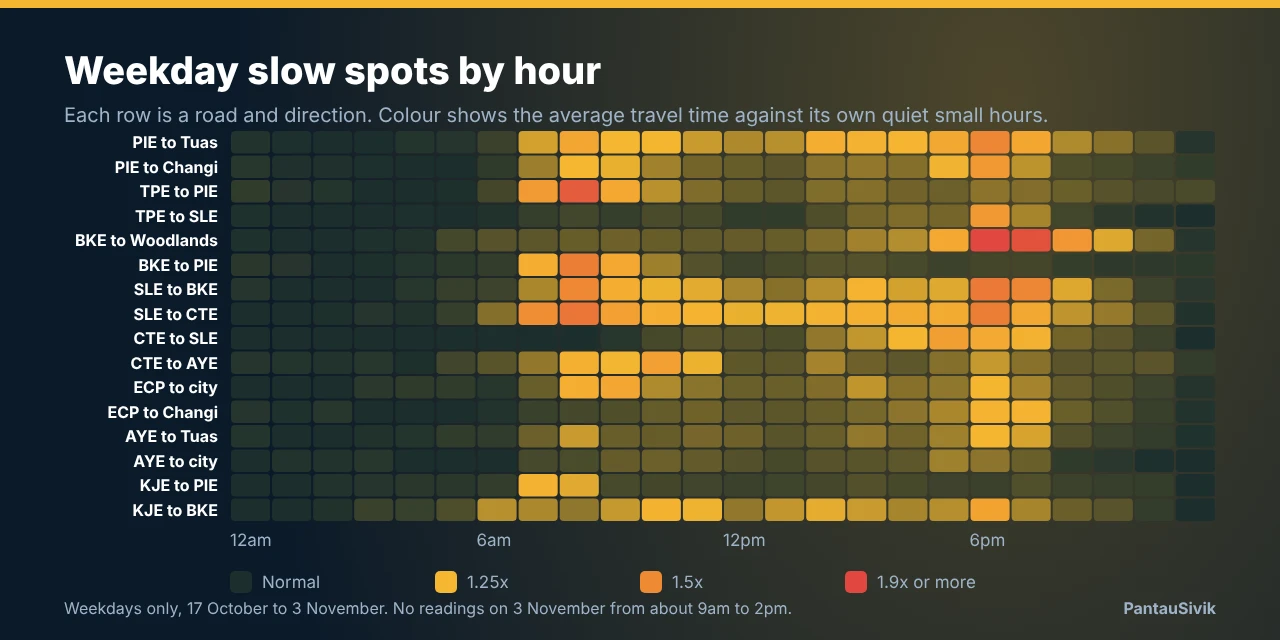
The chart below shows each road and direction by hour, coloured by how far it was above its own quiet time. Most rows light up in the same two places, the morning around 7 to 9am and the evening around 5 to 7pm, but a few are one sided. The TPE towards the PIE and the BKE towards the PIE are slow in the morning and fairly normal in the evening. The opposite directions, the TPE towards the SLE and the BKE towards Woodlands, are slow in the evening and fairly normal in the morning.
Direction matters
That one sided pattern is the clearest finding for planning. On the TPE, the direction towards the PIE took about 22 minutes at 8am against about 12 at night, while the direction towards the SLE barely changed in the morning. In the evening it was the other way round, at about 20 minutes towards the SLE at 6pm. The BKE is similar: towards the PIE in the morning (about 15 minutes at 8am, from about 10), towards Woodlands in the evening (about 18 minutes at 6pm).
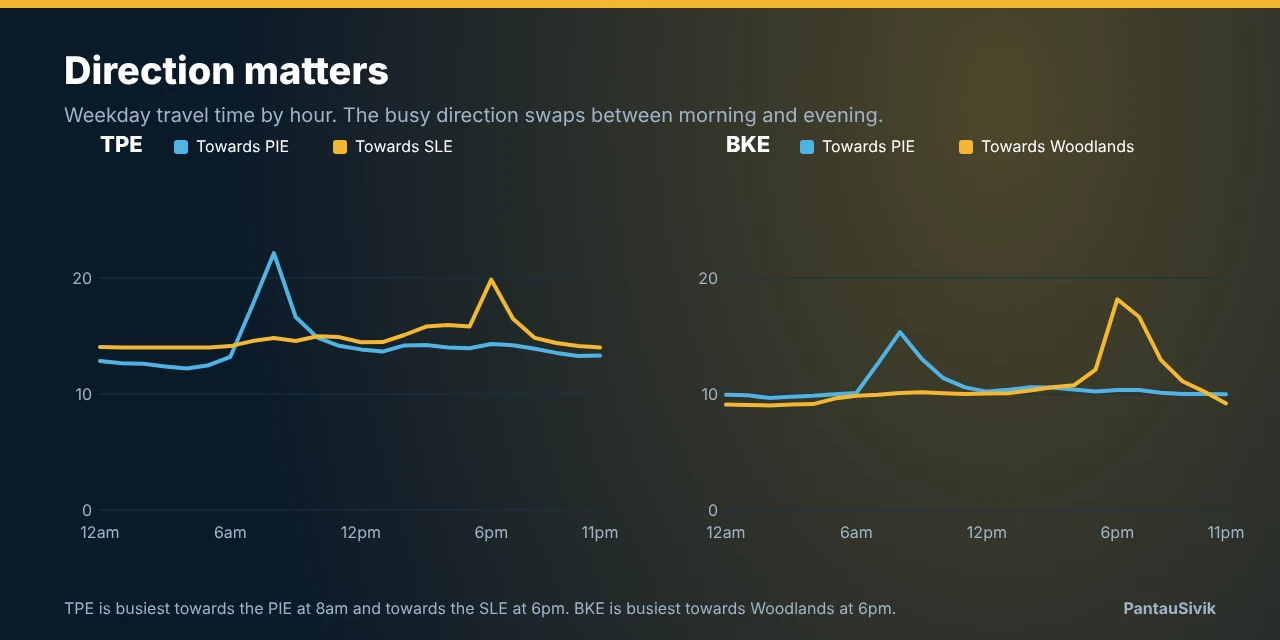
If you are choosing between leaving at 7am or 9am, or between 5pm and 8pm, the direction of your trip may matter more than the road.
Weekdays and weekends
With 18 days we can now compare weekdays and weekends properly. For each road and direction we took the busiest hour on weekdays and the busiest hour on weekends. The weekend peak was lower on all 16, by about 20% on average. In minutes the PIE gained the most, about 10 minutes towards Tuas and 11 towards Changi. In proportion the BKE towards Woodlands changed most: its evening peak fell from about 18 minutes to about 11, a drop of 42%. The TPE towards the PIE fell from about 22 minutes to 15.
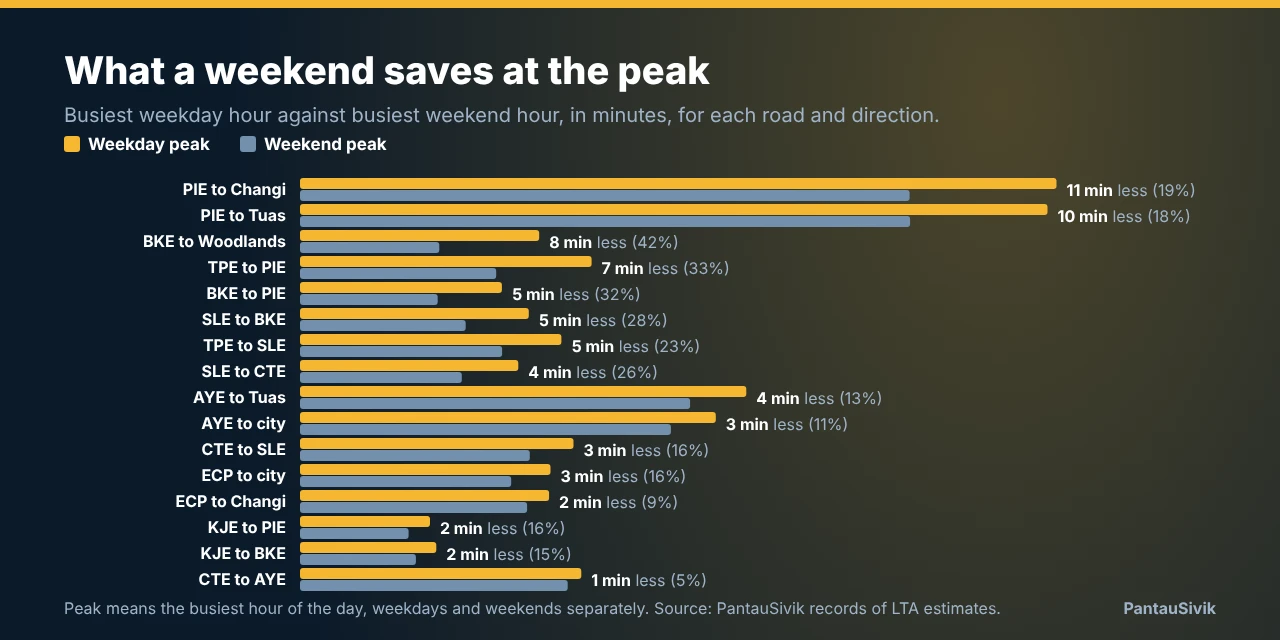
Not every road gets a break. The CTE towards the AYE hardly changed, at about 21 minutes on weekdays and 20 on weekends, and the ECP towards Changi dropped only about 2 minutes. Across the 16, 15 stayed below 1.25 times their quiet-hour time on weekends. The exception was the CTE towards the AYE.
Saturday and Sunday were not the same either. On the PIE between 10am and 8pm, the average of both directions was about 48 minutes on weekdays, about 46 on Saturdays (24 and 31 October) and about 43 on Sundays. That is only three Sundays and two full Saturdays, so treat it as a first look, but it suggests a Saturday daytime is closer to a weekday than a Sunday is.
Day by day
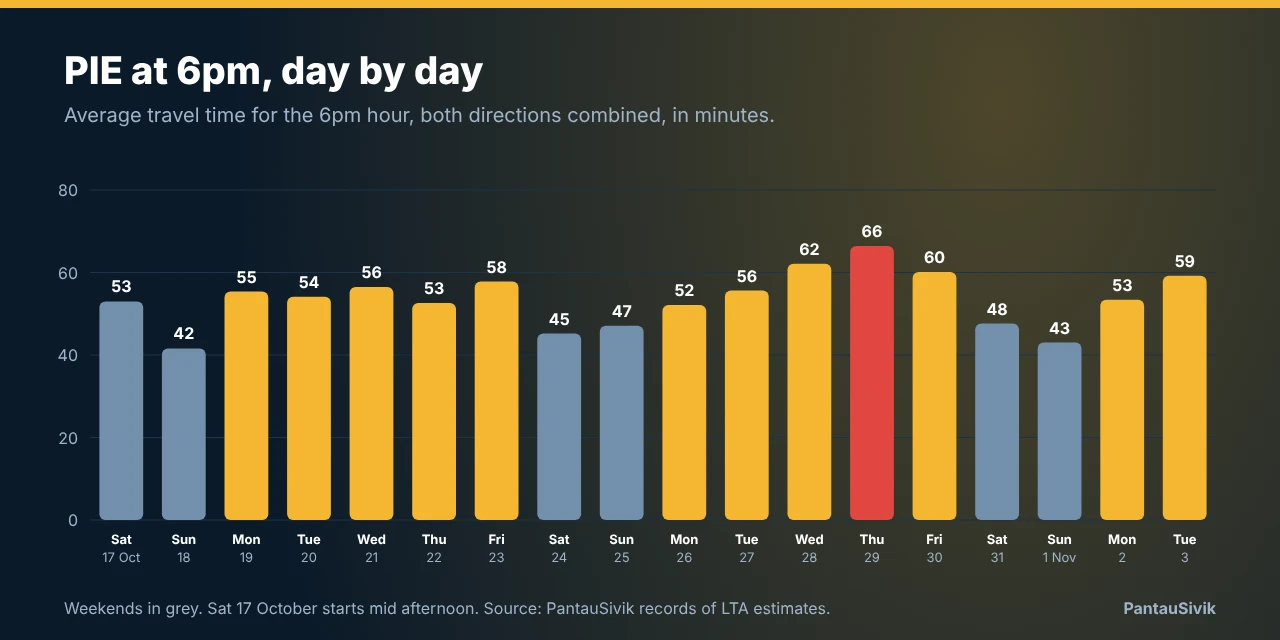
The 6pm hour on the PIE was fairly steady on weekdays at first, between 52 and 58 minutes, using both directions together. Then it rose. The highest day in our records is now Thursday 29 October, at about 66 minutes, after Wednesday 28 October at about 62, Friday 30 October at about 60 and Tuesday 3 November at about 59. Heavy rain warnings were logged earlier on 28 October, and the PIE was named in 81 road incident alerts that day, the most of any road. Those days were also stormy: our lightning records show 41,727 strikes on 28 October and 11,611 on 29 October. But stormy days were not always slow. Monday 2 November had 40,421 strikes, mostly between 1pm and 4pm, and the PIE at 6pm was about 53 minutes, inside the usual range. We only have a handful of such days, so we cannot say what caused the slow ones. Sunday 18 October, Saturday 24 and Sunday 25 October, Saturday 31 October and Sunday 1 November were the lowest, between about 42 and 48 minutes. The first Saturday, 17 October, was higher at about 53, though our records for it start in the afternoon.
What this does not tell you
- These are LTA estimates for each stretch, added together. They are not timed trips, and your trip may use only part of the road.
- We have 18 days, 12 weekdays and 6 weekend days, with no public holidays, so we cannot say how school holidays, long weekends or events change the picture. The weekday and weekend comparison rests on a small number of days.
- Rain, roadworks, accidents and breakdowns on a given day will move the numbers. See our post on road incidents by hour and road.
- The data has no MCE or KPE, and the stretches do not always reach the ends of a road.
- Direction labels come from LTA's start and end points for each stretch, so they are our reading of the data.
- We have no readings on 3 November from about 9am to 2pm, and a short gap in the early hours of 18 October, so the hourly averages for those hours use fewer days.
How to use this
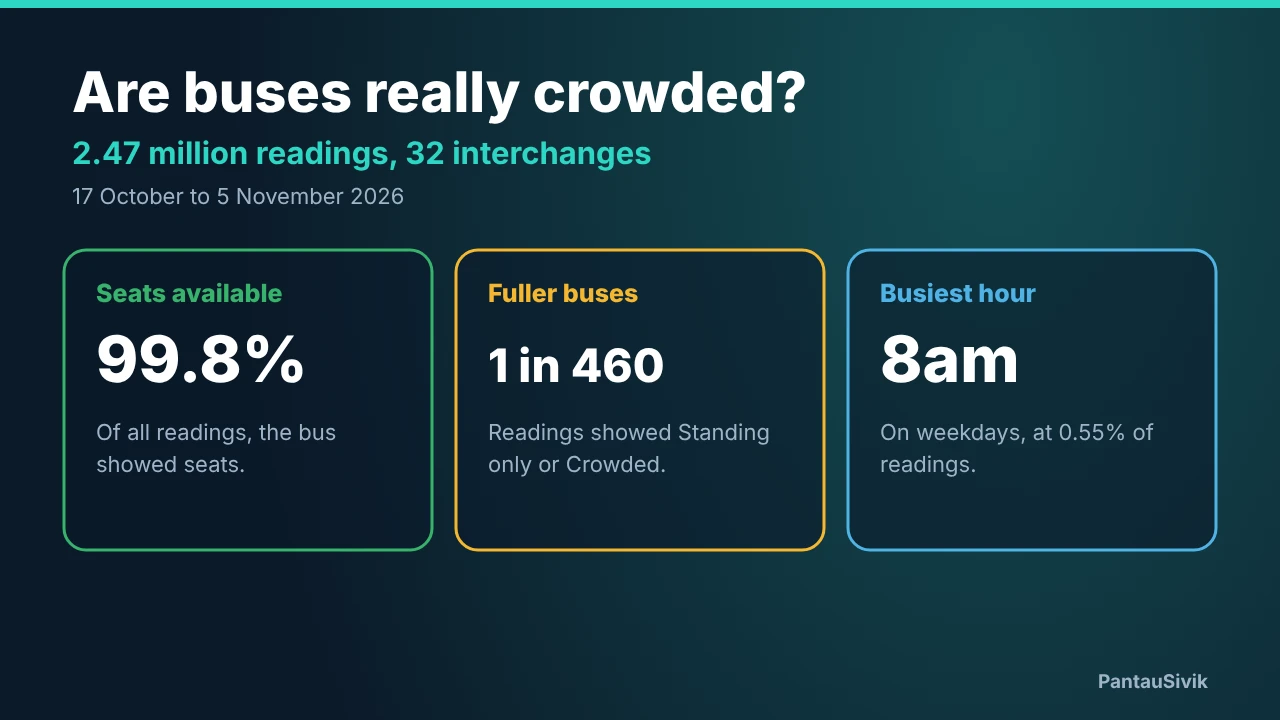
For a trip you plan ahead, check the direction and leave outside the peak hour where you can. A weekend trip on the PIE tends to be about 10 minutes faster at its peak than on a weekday, and a Sunday is the calmest day we have seen. Before you leave, look at the live estimate rather than the average, because a bad day can add much more. Our guide to traffic cameras and expressway travel times shows where to find the live figures, and the Public Alerts guide covers road incident alerts. For a bus trip, see our post on how crowded buses are.
We plan to keep collecting this and to look again when we have more weeks, including a school holiday.
Pick any expressway and compare days on the expressway travel times history page, which updates every week.
Common questions
How long does it take to drive the PIE at 6pm on a weekday?
In our records the PIE stretch LTA reports took about 57 minutes at 6pm on weekdays, against about 37 to 41 minutes in the small hours. That is the whole stretch from the ECP interchange to the AYE interchange, so most trips use only part of it.
Which expressway slows down the most at peak hour?
Measured against its own quiet hours, the BKE towards Woodlands at 6pm (2.0 times), the TPE towards the PIE at 8am (1.8 times) and the SLE (about 1.6 times) slowed the most. The PIE added the most minutes, about 17 to 19.
Are weekends faster than weekdays on the expressways?
Yes. The PIE peaked at about 46 minutes on weekends, against about 57 on weekdays. Across all 16 road and direction combinations, the busiest weekend hour was on average about 20% shorter than the busiest weekday hour, and 15 of the 16 stayed below 1.25 times their quiet hours.
Where do these travel times come from?
They are LTA estimated travel times for each stretch of expressway, which the app records about every 15 minutes. We add the stretches up for each road and direction. They are estimates, not timed trips.
Sources: PantauSivik's own records of LTA expressway estimated travel times, 17 October to 3 November 2026, 1,642 snapshots. Saturday 17 October starts in the afternoon, and there are no readings on 3 November from about 9am to 2pm.
Information in PantauSivik comes from public sources and is there to help you plan. In an emergency, follow official channels. PantauSivik is independent and not affiliated with any government agency.
See also: Road incidents, 18 to 27 October, Traffic cameras and expressway travel times, F1 weekend road closures, Night road closures and bus diversions, Are buses really crowded?, Singapore week in data, 17 to 29 October, Lightning in Singapore, 17 October to 3 November, How fast is Singapore's traffic, hour by hour?.