Home / Blog / Environment
Lightning in Singapore, 17 October to 3 November: 256,094 strikes, mostly in the afternoon
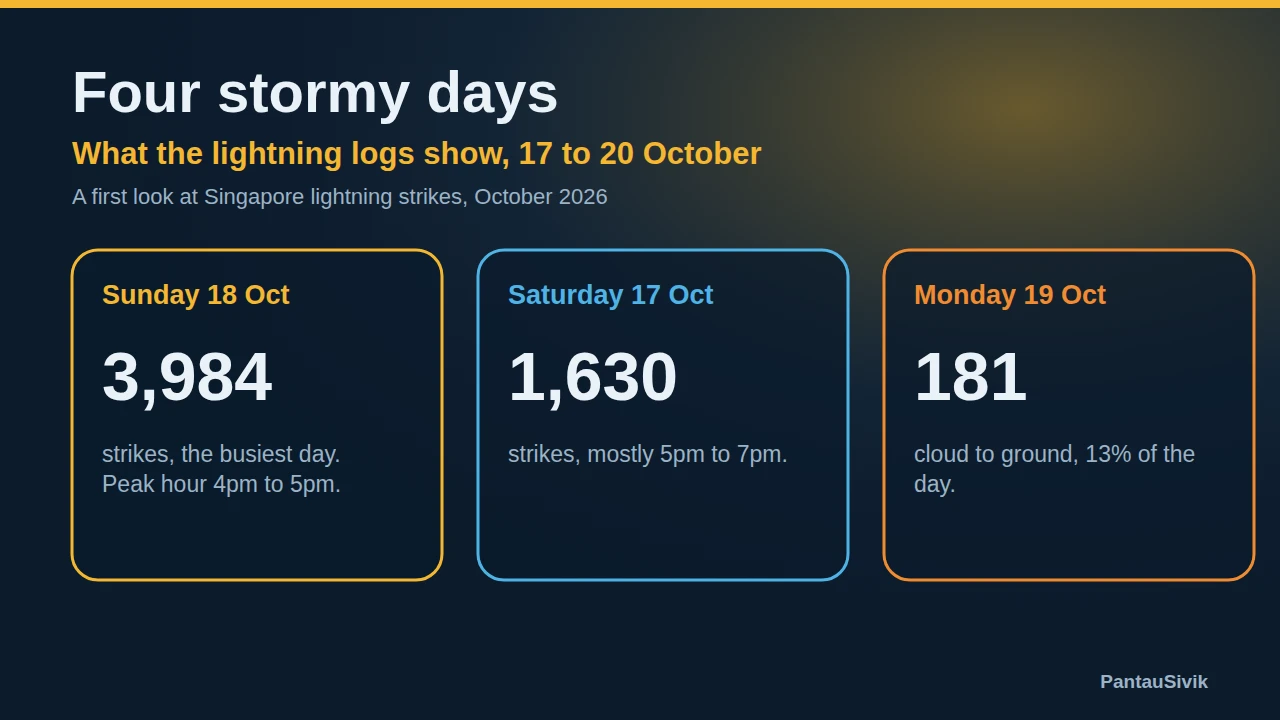
PantauSivik has now kept hourly lightning records for 18 days, from Saturday 17 October to Tuesday 3 November 2026. Our earlier posts looked at four stormy days and the 24 October storm. This one steps back to ask a planning question: when in the day does it happen, and how often do the big days come? The Meteorological Service Singapore outlook issued on 29 October expects moderate to heavy thundery showers on most days in the first half of November, so the pattern is worth knowing.
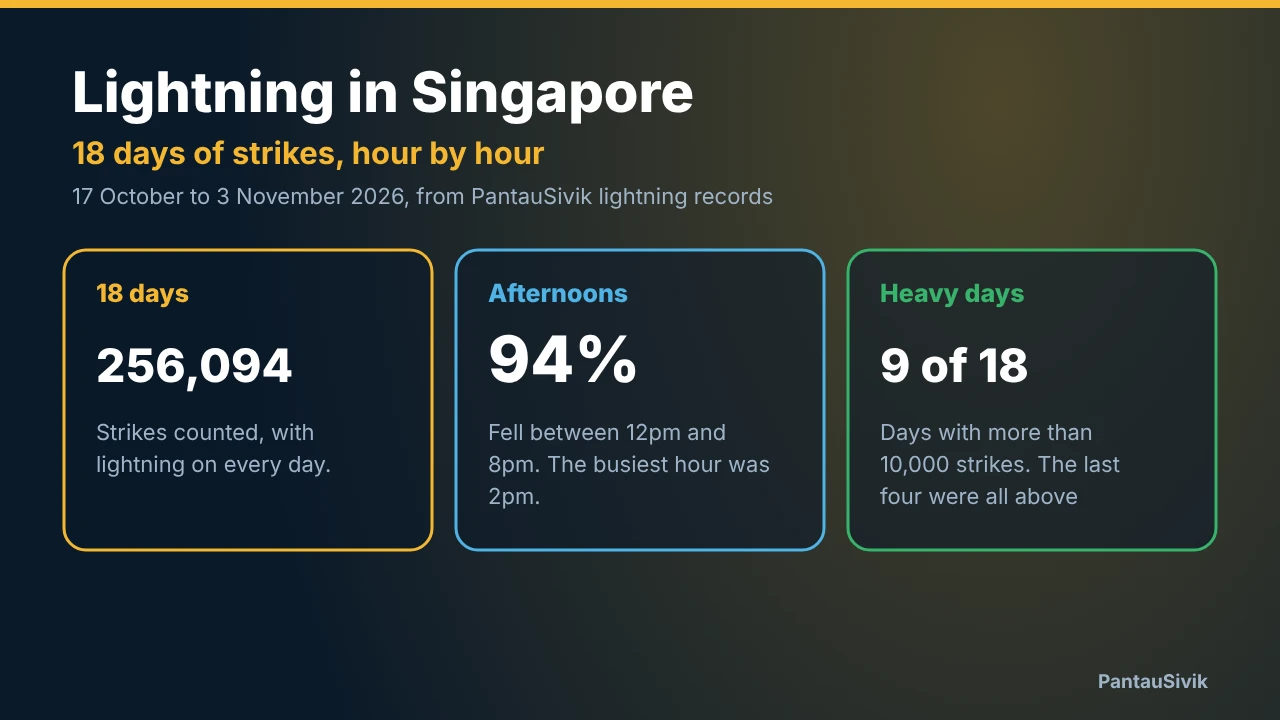
In short: we recorded 256,094 strikes in 18 days, with lightning on every day. About 94% fell between 12pm and 8pm, and the hour from 2pm held about 29%. Nine days passed 10,000 strikes and made up 91% of the total. The newest days were heavy: Monday 2 November had 40,421 strikes, including 26,181 in the 2pm hour. Only about 3.1% of strikes reached the ground.
What we count
The numbers are lightning strikes across Singapore, added up for each hour and split into cloud to cloud, which stay in the sky, and cloud to ground. We match a strike to one of the 47 NEA sectors when it is within 8 km of it, the same sectors you can pick under My sectors. A strike farther away still counts for the day but belongs to no sector. All times are Singapore time, and the counts are our own, not an official total.
The afternoon pattern
Add every day together and almost everything falls in one window. Between 12pm and 8pm we counted about 241,000 of the 256,094 strikes, 94%. The single busiest hour was 2pm to 3pm with 73,359, about 29%, and the three hours from 1pm to 4pm together held about 70%. Before noon there were only about 3.5% of strikes, and after 8pm about 2.3%.
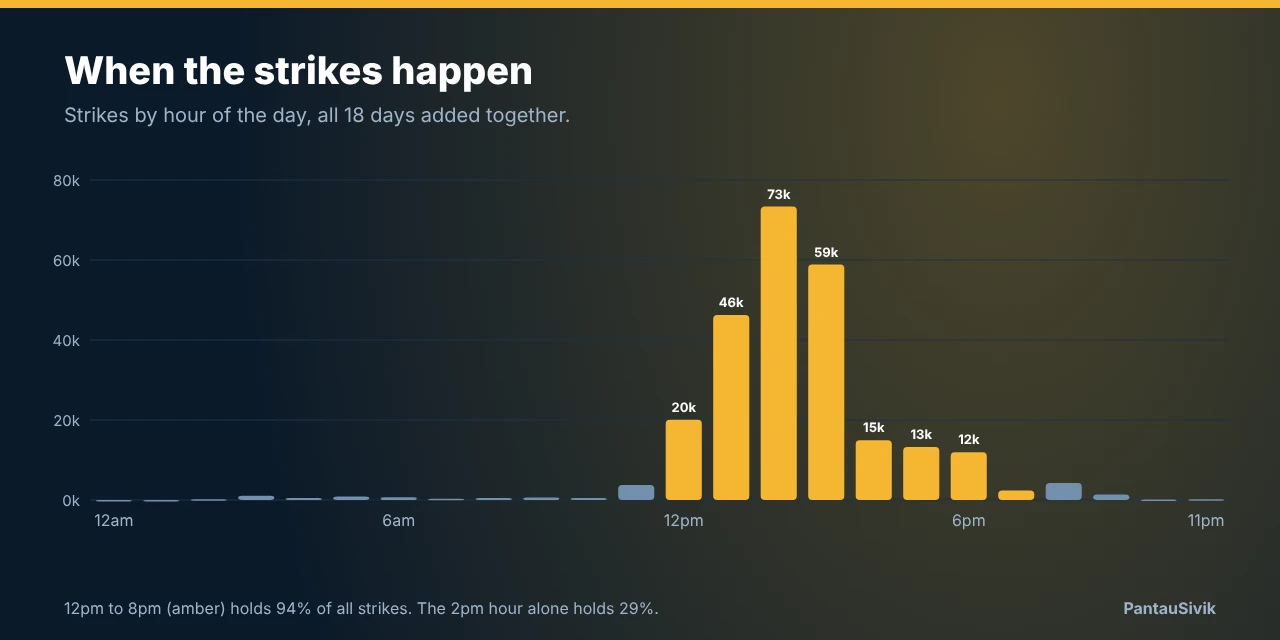
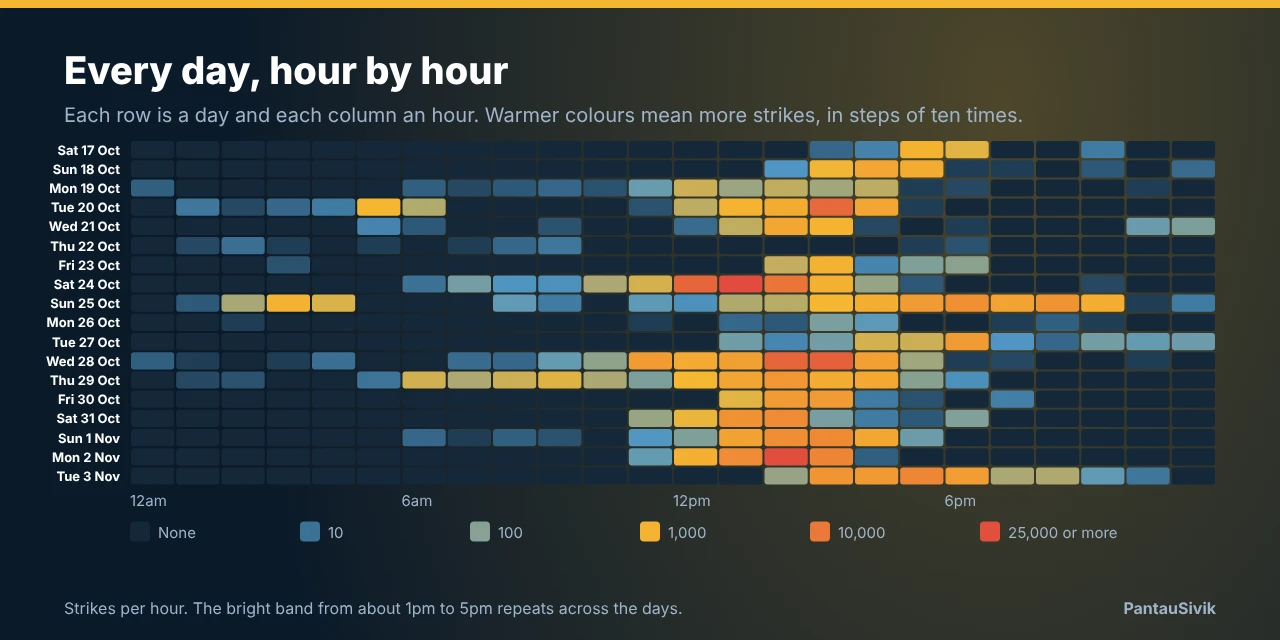
It is not only a total. On 16 of the 18 days the busiest hour was between 1pm and 7pm. The two exceptions were Monday 19 October, when the noon hour led with 368 strikes, and Thursday 22 October, a day with only 37 strikes in all, led by 12 at 9am. A few stormy days also had strikes in the early morning, for example Sunday 25 October, with 1,056 in the 3am hour, but those hours were small next to the afternoon.
Big days and quiet days
The days are very uneven. Nine of the 18 passed 10,000 strikes, and together they made up 91% of the total. The other nine added only 22,995 strikes between them, and Thursday 22 October (37) and Monday 26 October (147) were close to silent.
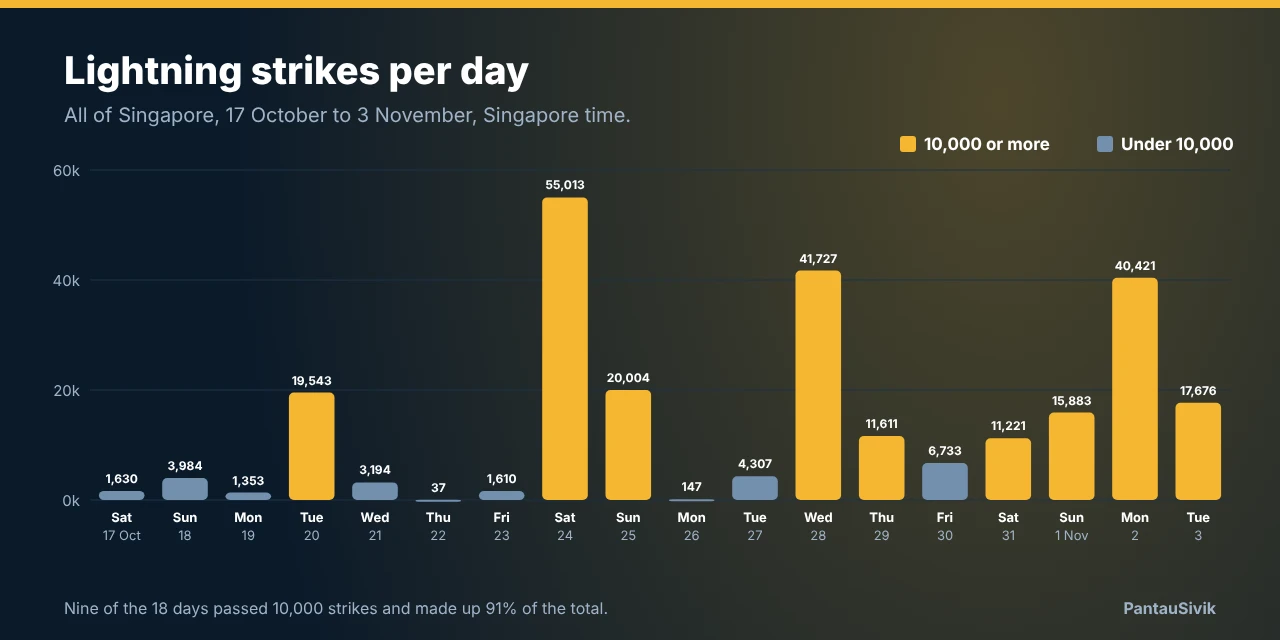
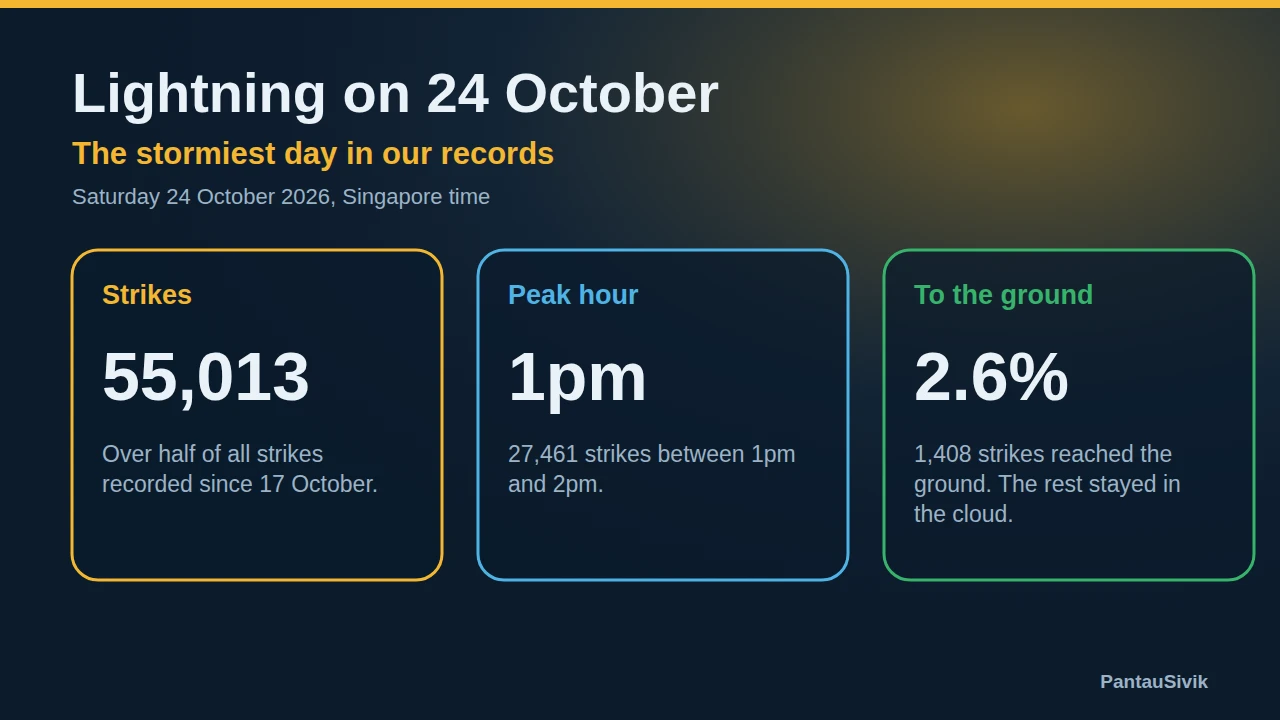
The latest stretch has been the heaviest. The nine days from 26 October to 3 November had 149,726 strikes, about 41% more than the 106,368 in the first nine days from 17 to 25 October, and each of the last four days (31 October to 3 November) passed 11,000. Monday 2 November was the third biggest day after Saturday 24 October (55,013) and Wednesday 28 October (41,727). About 97% of its 40,421 strikes came between 1pm and 4pm, and the 2pm hour had 26,181, second only to the 27,461 in the 1pm hour on 24 October.
Weekdays and weekends
The 6 weekend days averaged about 17,956 strikes and the 12 weekdays about 12,363, but that is mostly one day. Saturday 24 October alone was 51% of the weekend total. Without it the 5 other weekend days averaged about 10,544, a little below weekdays. With 18 days we cannot say that one kind of day is stormier than the other.
How many reach the ground
Cloud to ground strikes matter most to people outdoors. Across the 18 days, 7,961 of the 256,094 were cloud to ground, about 3.1%. A bigger storm does not mean a bigger share. The three biggest days, 24 October, 28 October and 2 November, had 2.6%, 2.2% and 2.0%. Among days with more than 1,000 strikes the share ranged from 0.6% on Saturday 17 October to 13.4% on Monday 19 October. Very small days can look high in percentage terms only because the count is tiny.
Where the strikes were counted
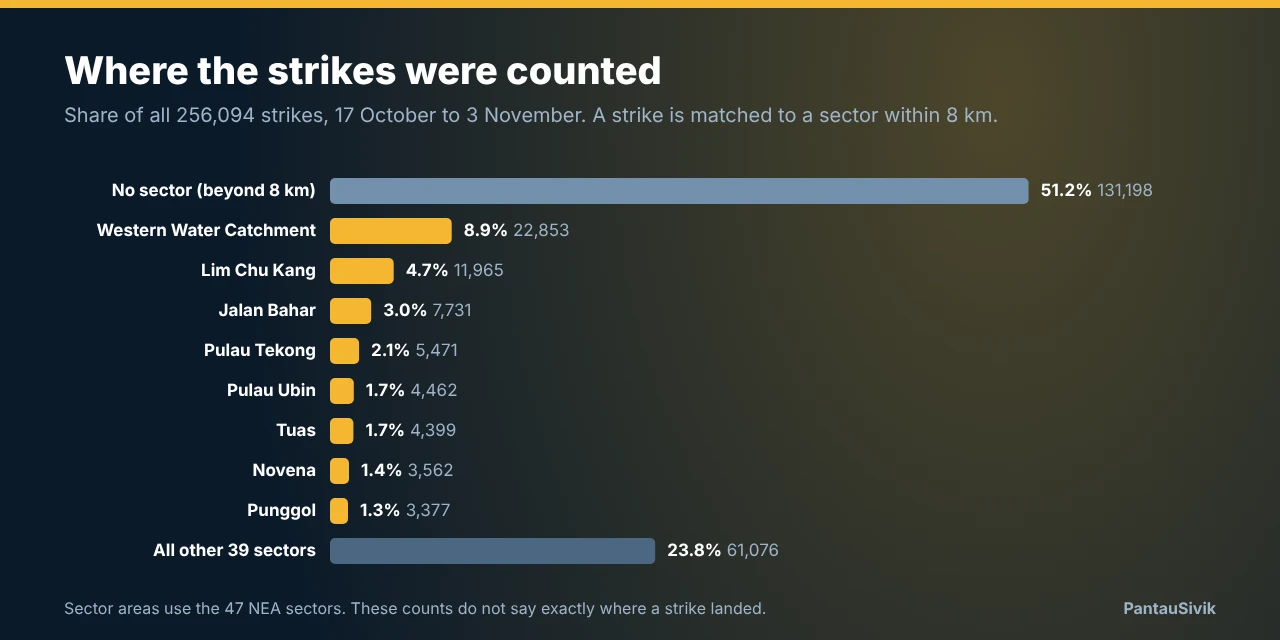
About 51% of the strikes were not within 8 km of any sector, so they belong to no sector. They were most likely over water or beyond the island, but these totals do not say where exactly. Of the rest, the Western Water Catchment had the most, 22,853 strikes or 8.9%, followed by Lim Chu Kang (11,965) and Jalan Bahar (7,731). On 2 November the leaders were the Western Water Catchment (7,526), Jalan Bahar (3,397) and Novena (2,607).
What it means for you
- Mornings were calm. Only about 3.5% of strikes came before noon. If you have outdoor plans on a day with thundery showers in the forecast, earlier is safer in our records, but not safe from every storm.
- Expect the afternoon. The 1pm to 4pm window carried about 70% of all strikes, and some storms ran into the evening, as on Tuesday 3 November, when the busiest hour was 5pm.
- A big count does not mean danger at your spot. A strike counted in a sector can be several kilometres from you, and half the strikes were in no sector at all.
- Set up sector alerts. Choose up to 4 sectors under My sectors so alerts name the places you care about. See the Public Alerts guide and how to set up sector alerts. The Weather page shows strikes near you right now.
- If you can hear thunder, move indoors, and follow official advice.
Roads on stormy days
Lightning does not map neatly onto traffic. On Monday 2 November, with 40,421 strikes mostly between 1pm and 4pm, the PIE at 6pm took about 53 minutes, inside its usual range. The slowest PIE evening in our records, about 66 minutes, was on Thursday 29 October, a day with 11,611 strikes. See our post on expressway travel times by hour.
What this does not tell us
- It is 18 days in one inter-monsoon spell, so it does not show what is normal for Singapore or for the time of year.
- The counts are our own, by the hour, and may not match other lightning records.
- Sector areas are 8 km matches, not exact locations, and half of the strikes belong to no sector.
- We did not look at what caused each storm, or at rainfall. A lightning count and a rain warning measure different things.
- Our records for Saturday 17 October start in the afternoon, so that day may be incomplete.
The lightning history page keeps these totals up to date, with strikes per day and a chart of the busiest hours.
Common questions
How many lightning strikes were there in Singapore from 17 October to 3 November 2026?
PantauSivik recorded 256,094 lightning strikes in 18 days, with strikes on every day. Nine of the days passed 10,000 strikes and made up about 91% of the total. These are our own counts, not an official total.
What time of day does lightning happen in Singapore?
In our records about 94% of strikes fell between 12pm and 8pm, and the hour from 2pm alone held about 29%. Only about 3.5% came before noon and 2.3% after 8pm. The busiest hour of the day was between 1pm and 7pm on 16 of the 18 days.
Is lightning more common on weekends in Singapore?
Not in a way we can show. The 6 weekend days averaged about 17,956 strikes and the 12 weekdays about 12,363, but one Saturday, 24 October, made up 51% of the weekend total. Without it the weekend average was about 10,544.
How many lightning strikes reach the ground?
7,961 of the 256,094 strikes, about 3.1%, were cloud to ground. The rest were cloud to cloud and stayed in the sky. On the three biggest days the share was 2.0 to 2.6%.
Where in Singapore do the most lightning strikes happen?
About 51% of the strikes were not within 8 km of any of the 47 NEA sectors we use. Of the rest, Western Water Catchment had the most, 22,853 strikes or 8.9%, followed by Lim Chu Kang with 11,965 and Jalan Bahar with 7,731. These counts do not say exactly where a strike landed.
Sources: PantauSivik's own lightning records, 17 October to 3 November 2026, in Singapore time. Strike counts are by the hour. Sector areas use the 47 NEA sectors, with a strike matched to a sector when it is within 8 km. Outlook for 1 to 15 November, issued by the Meteorological Service Singapore on 29 October 2026, as reported by AsiaOne.
Information in PantauSivik comes from public sources and is there to help you plan. In an emergency, follow official channels. PantauSivik is independent and not affiliated with any government agency.
See also: Lightning on 24 October, Four stormy days: our first lightning records, Expressway travel times by hour, Rain in Singapore for visitors, Public Alerts guide, Weather, PSI and UV guide, Set up sector alerts, Singapore week in data, 17 to 29 October, Singapore week in data, 30 October to 5 November, Singapore week in data, 30 October to 5 November.