Home / Blog / Environment
Singapore week in data, 30 October to 5 November: storms, the slowest PIE yet and new alerts
PantauSivik now has about three weeks of public data on file. This is the second weekly roundup. It covers Friday 30 October to Thursday 5 November and updates the numbers from our first one, 17 to 29 October: lightning, road incident alerts, the PIE at 6pm and buses. Dengue gets a short update. The last section covers alerts that only started showing up in our records in the past week. Everything here comes from our own records of public data, so it is a record of what we logged, not an official count. All times are Singapore time.
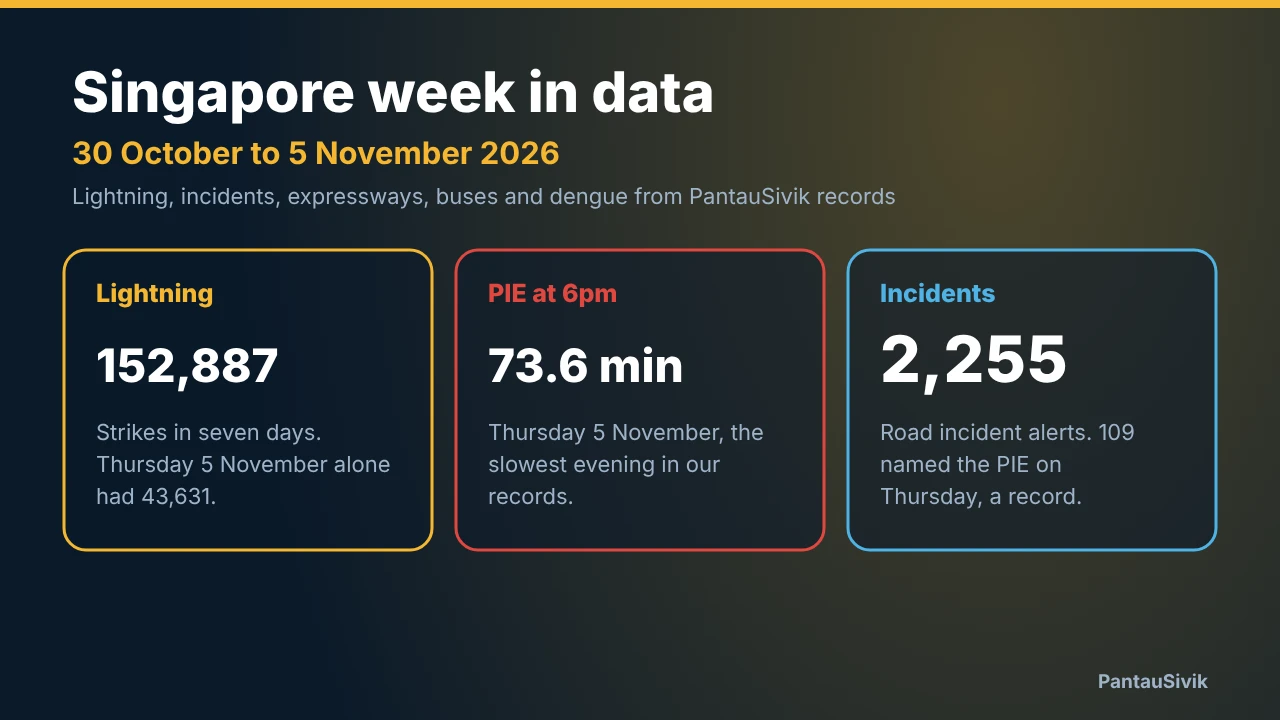
In short: lightning came to 152,887 strikes, and Thursday 5 November had 43,631 of them, the second biggest day since 17 October. There were 2,255 road incident alerts, and 109 of Thursday's named the PIE, the most of any day. The PIE at 6pm took 73.6 minutes that evening, the slowest in our records. Buses were still mostly seats. Dengue cluster alerts were logged only once after 30 October. Heat stress alerts began on 30 October and Malaysia alerts on 5 November.
Lightning: two big days, 2 and 5 November
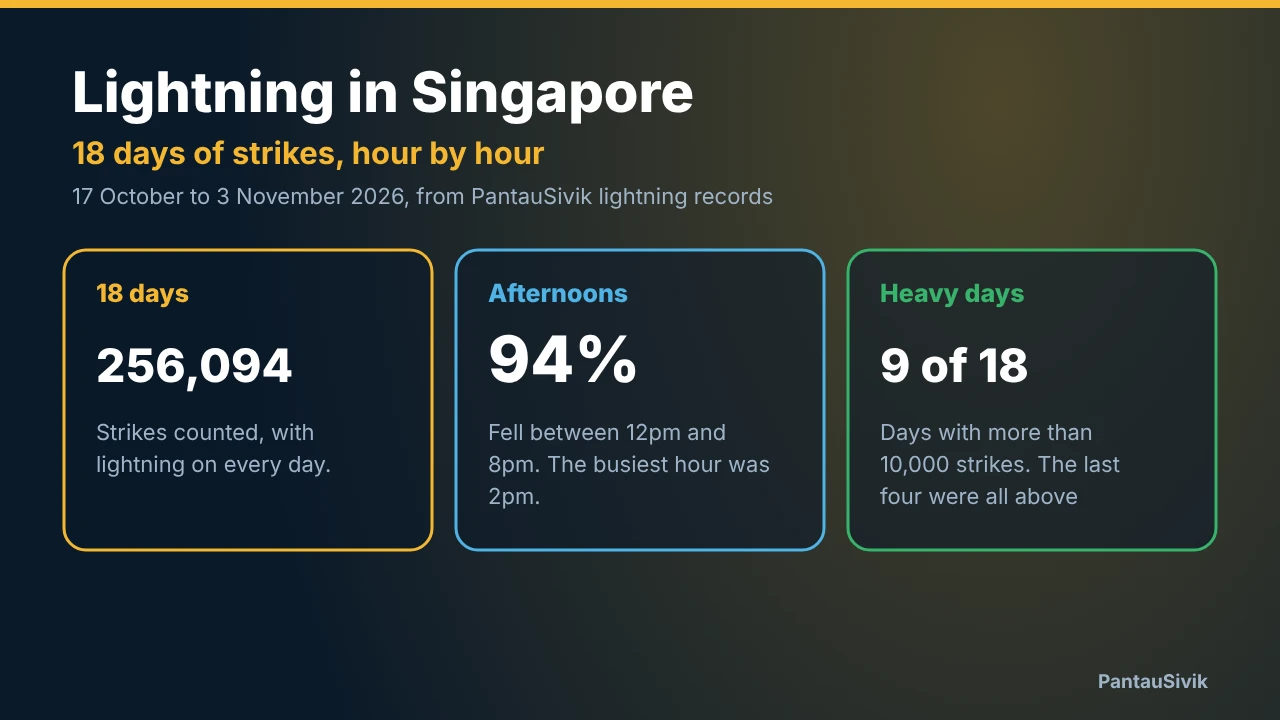
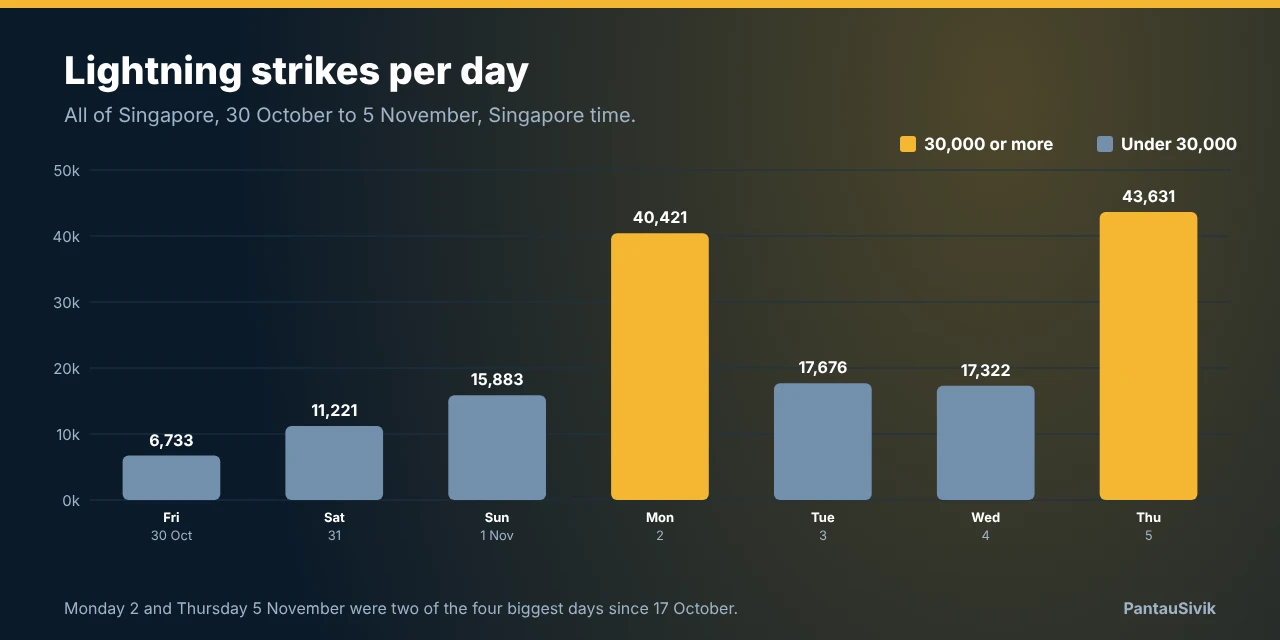
From 30 October to 5 November we counted 152,887 lightning strikes, which takes the total since 17 October to 317,047. Two days did most of the work. Monday 2 November had 40,421 strikes, and 26,181 of them fell in the 2pm hour. Thursday 5 November had 43,631. Over the 20 days that puts it second, behind Saturday 24 October (55,013) and just ahead of Wednesday 28 October (41,727).
The two days looked different. Monday was a single burst at 2pm. Thursday built up, with 6,179 strikes in the 1pm hour, then peaked at 5pm with 13,195 and was nearly over by 7pm, when only 501 were logged. The other five days ran from 6,733 on Friday 30 October to 17,676 on Tuesday 3 November.
Heavy rain warnings were logged on 30 October, 1 November and 2 November, two on each day. None showed up on 3, 4 or 5 November, including the day with 43,631 strikes. A warning and a strike count measure different things, and our records only hold the warnings the app received. For the longer view, see Lightning in Singapore, 17 October to 3 November and our first post on the four stormy days.
Road incidents: a busy Friday and Thursday
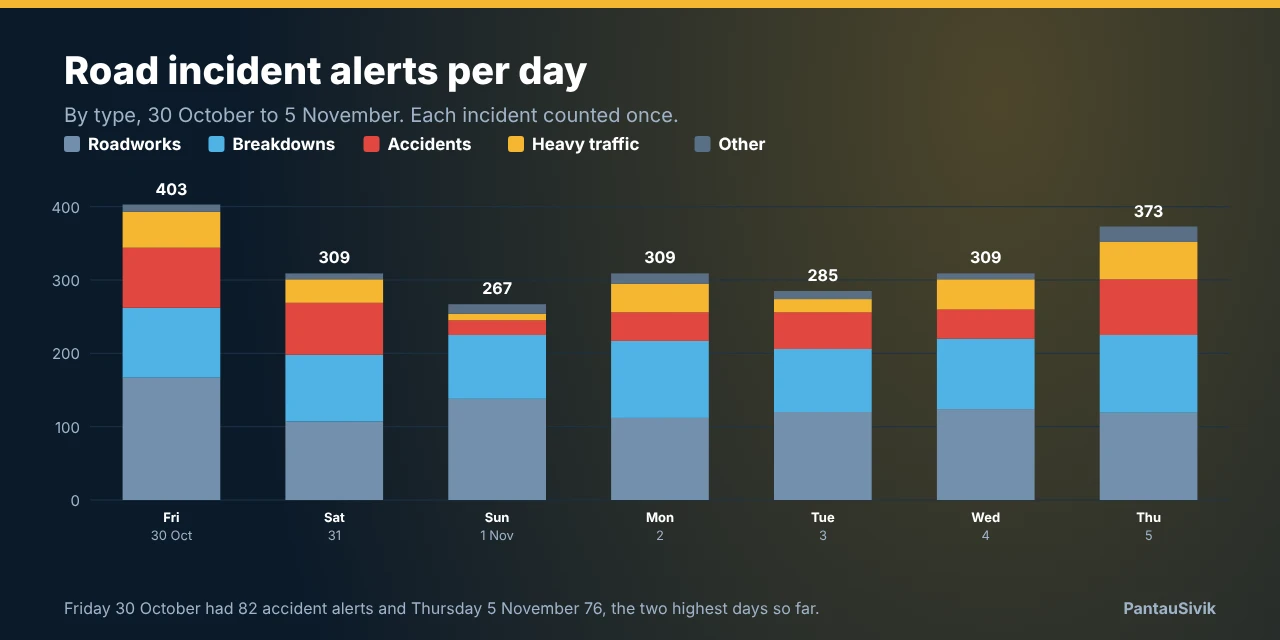
PantauSivik logged 2,255 road incident alerts over the seven days, counting each incident once. Roadworks made up 887 of them, vehicle breakdowns 666, accidents 378, heavy traffic 239 and other types 85. Friday 30 October was the busiest day with 403, then Thursday 5 November with 373. Sunday 1 November was the quietest at 267, with only 20 accident alerts.
Accident alerts were higher than in the first roundup. Friday 30 October had 82 and Thursday 5 November 76, against the 63 we reported for Thursday 29 October. For expressways, we counted alerts that name a road. The PIE had 570 over the week, the AYE 265, the TPE 232, the SLE 183 and the BKE 175. Thursday 5 November had 109 alerts that named the PIE, more than the 105 on 29 October. Friday 30 October had 100.
The PIE at 6pm: 73.6 minutes on Thursday
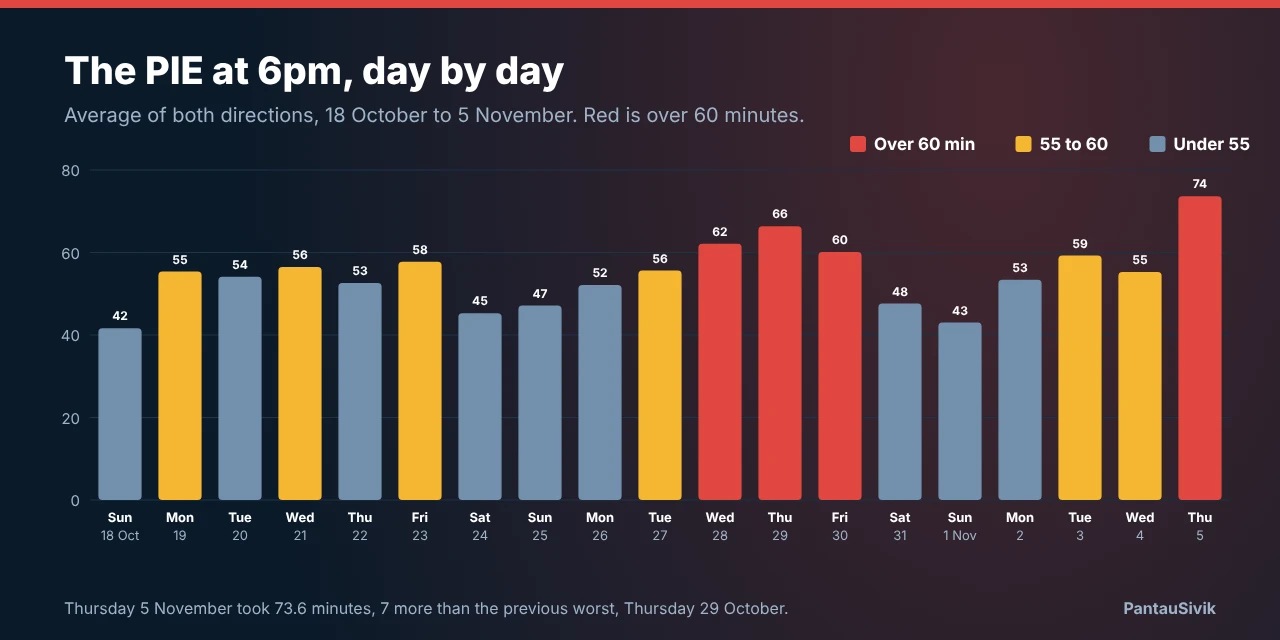
Averaging both directions of the PIE stretch LTA reports, 6pm on Thursday 5 November took 73.6 minutes. That was 71.5 minutes towards Tuas and 75.8 towards Changi, and about seven minutes worse than the previous slowest evening, 66.4 minutes on Thursday 29 October. The rest of the week was in the usual range: 60.1 minutes on Friday 30 October, 47.6 and 43.0 on the weekend, then 53.4, 59.2 and 55.2 from Monday to Wednesday.
Thursday also had the most PIE incident alerts of any day, 76 accident alerts and 43,631 lightning strikes. Our records show no heavy rain warning that day. Several of these may be linked, but with a few days of data we cannot tell which one slowed the PIE, or whether it will happen again. Tuesday 3 November is missing travel time readings from about 9am to 2pm. The 6pm figure is not affected.
For how each expressway changes through the day, see Expressway travel times by hour.
Road speeds
Our road speeds post covers 18 October to 4 November and found island wide speeds near 24 to 25 km/h for most of the day. Its slowest hour was 3pm on Monday 2 November, at about 22.5 km/h, which was the afternoon of the 40,421 strikes. It does not yet include Thursday 5 November.
Buses: still mostly seats
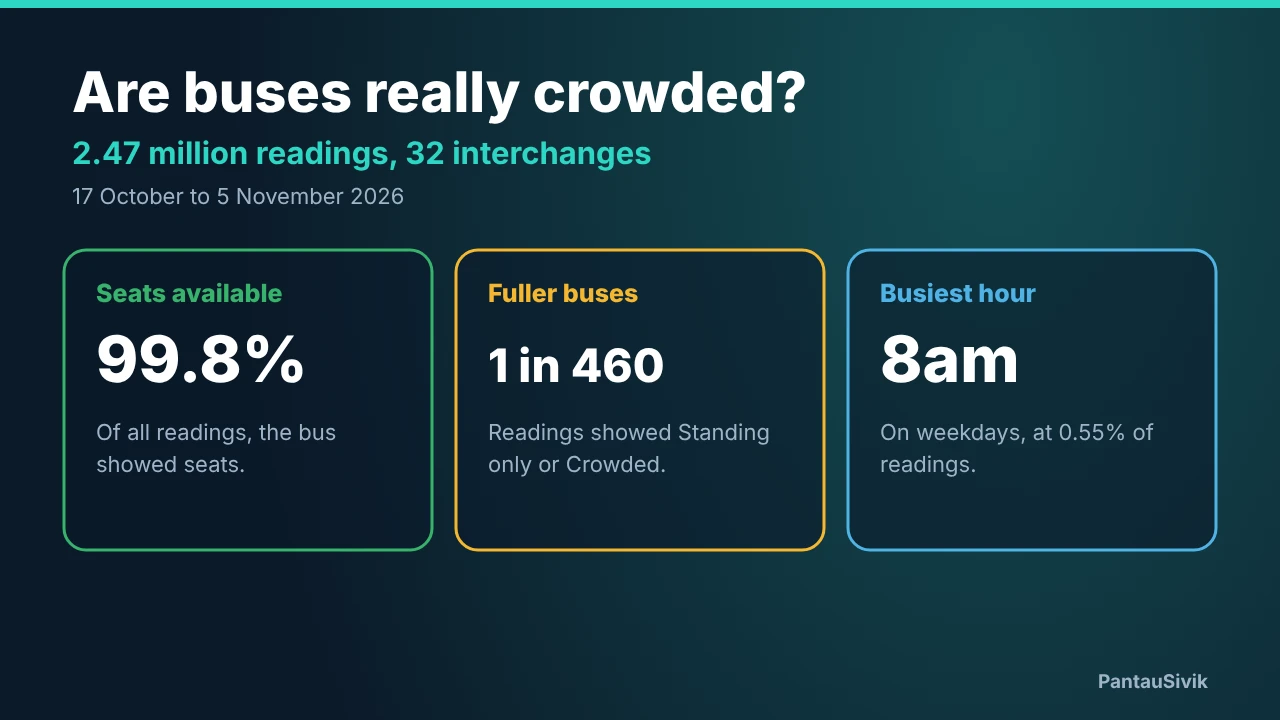
We have updated Are buses really crowded? with readings to 5 November. Across 2,469,147 readings from 32 interchanges, 5,362 showed Standing only or Crowded, about 1 in 460, or 0.22%. The daily share ran between 0.18% and 0.25%. One change: on weekdays the fullest hour is now 8am (0.55%), a little ahead of 7am (0.51%).
Bus service alerts are a different feed. We logged 14 of them this week. Services 170 and 170X, the Woodlands diversion in our bus alerts post, had an alert on four of the seven days: 30 and 31 October, 2 November and 4 November. Other alerts named 912 and 912A on 30 October, 24, 27, 34, 36, 53, 110 and 858 on 1 November, 922 on 2 November, and 15, 21, 27 and 168 on the evening of 5 November.
Dengue clusters: one alert after 30 October
Since 18 October we have logged 78 "New dengue cluster" alerts. A normal batch arrived on 30 October (12 distinct clusters), the snapshot in our first roundup. After that came a single alert on 1 November, for Lentor Hills Road near Lentor Gardens, with 2 cases. We logged none from 2 to 5 November. We cannot say why from our side, so the 30 October list should be treated as the last full snapshot we have: 12 clusters and 157 cases, with 100 of them in Jurong East. The NEA website has the current clusters and map.
New in our records this week
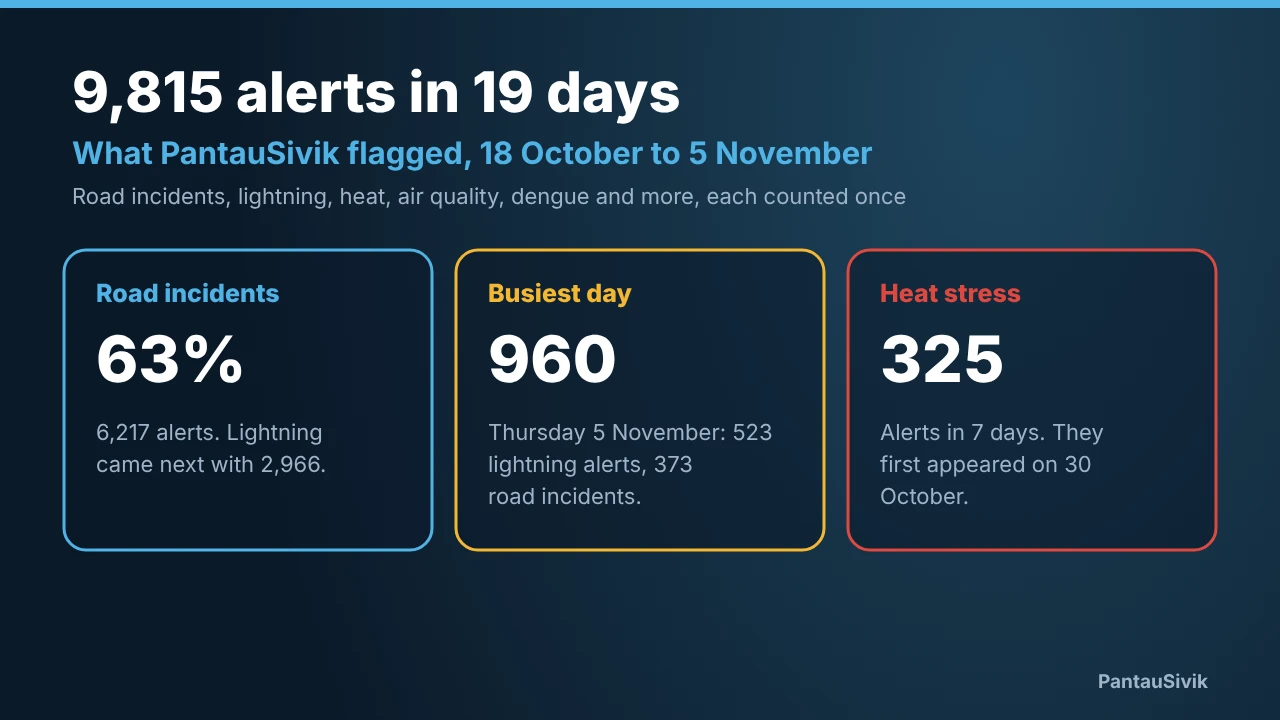
- Heat stress alerts. The first one in our records is from 30 October. By 5 November there were 325, of which 313 were Moderate and 12 were High. Wednesday 4 November had 69, and most came between 10am and 2pm.
- Very High UV alerts. Six so far, on 29 and 30 October and on 1, 3, 4 and 5 November, each first flagged at 2pm or 3pm.
- Malaysia alerts. 55 appeared at 5:05pm on 5 November: 36 weather warnings, such as thunderstorm warnings for Johor, Kedah and Kelantan, and 19 "Air quality Unhealthy" readings.
We put every type of alert side by side, by day and by hour, in 9,815 alerts in 19 days.
What this does not tell you
- These are records from PantauSivik, built on public data, and some days are partial. They are not official totals.
- Lightning counts say nothing about where a strike landed or whether it reached the ground.
- Incident alerts count notices, not crashes. Travel times are LTA estimates.
- The dengue figures are the last full snapshot we have, and case counts are not new cases per day.
- One day of a slow PIE is not a trend, and 20 days is short.
The charts behind this post are kept up to date on the History pages: lightning, expressway travel times, bus crowding and alerts.
Common questions
How many lightning strikes did PantauSivik record from 30 October to 5 November 2026?
152,887 strikes over seven days. Thursday 5 November had 43,631 and Monday 2 November had 40,421. Together with 17 to 29 October, that makes 317,047 strikes since 17 October.
How slow was the PIE on Thursday 5 November?
At 6pm the PIE stretch LTA reports took about 73.6 minutes, averaging both directions. It was about 71.5 minutes towards Tuas and 75.8 towards Changi. The previous slowest evening in our records was 66.4 minutes on Thursday 29 October.
How many road incident alerts did Singapore have from 30 October to 5 November 2026?
PantauSivik logged 2,255 road incident alerts, counting each incident once. Roadworks were 887, vehicle breakdowns 666, accidents 378, heavy traffic 239 and other types 85. Thursday 5 November had 109 alerts that named the PIE, the most of any day so far.
Were there new dengue cluster alerts after 30 October?
Only one in our records. It was on 1 November, for Lentor Hills Road near Lentor Gardens, with 2 cases. We logged none from 2 to 5 November. Check the NEA website for the current list of clusters.
Sources: PantauSivik records of public data, 30 October to 5 November 2026 (lightning, road incident alerts, bus load readings at 32 interchanges, bus service alerts, LTA expressway estimated travel times, NEA dengue cluster alerts, heat stress, UV and Malaysia alerts as shown in the app).
Information in PantauSivik comes from public sources and is there to help you plan. In an emergency, follow official channels. PantauSivik is independent and not affiliated with any government agency.
See also: Week in data, 17 to 29 October, 9,815 alerts in 19 days, Lightning in Singapore, 17 October to 3 November, Are buses really crowded?, How fast is Singapore's traffic?, Expressway travel times by hour, Bus service alerts, 17 to 30 October, Public Alerts guide.