Home / Blog / Environment
Rain in Singapore for visitors: how to plan around downpours and thunderstorms
Singapore is warm and humid all year, and rain is part of the picture. Most showers pass quickly, but a thunderstorm can still wreck an outdoor plan, and a wet December can stay grey for days. If you are visiting, a little knowledge helps you plan around the weather instead of being caught by it. This guide covers what to expect from October to January, what the alerts mean, and how to use PantauSivik to plan your day.
In short: expect afternoon thunderstorms in October and November and steadier, widespread rain from December. Check the Weather page before you head out, set Lightning and Flood alerts to your sectors, and keep a covered or indoor plan ready for each outing.
What rain to expect, month by month
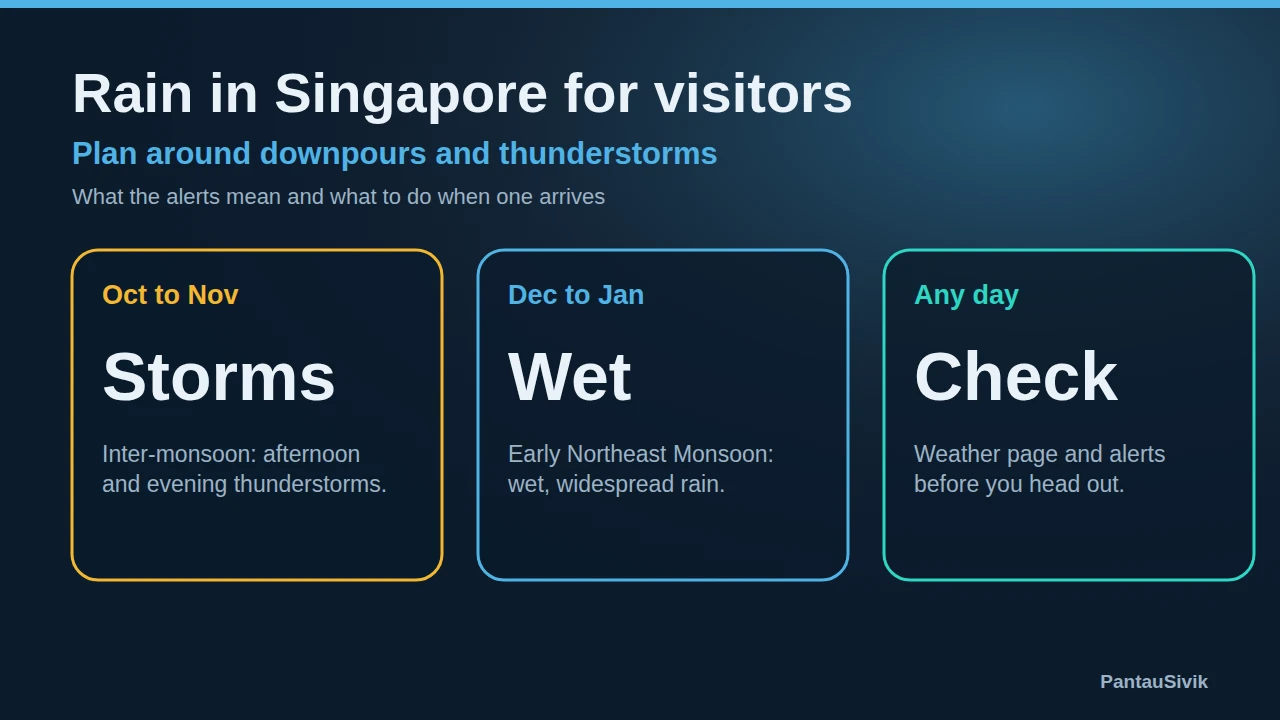
According to NEA, October to November is an inter-monsoon period with light and shifting winds. It brings afternoon and early evening thunderstorms, sometimes severe, and it is generally wetter than the other inter-monsoon months. From December, the Northeast Monsoon begins. NEA says its early phase, from December to early January, is wet, with surges that bring steady, widespread rain and stronger winds, and with showers that are frequent in the afternoon and evening. The later phase, from late January to early March, is windier and drier.
In plain terms, if you are visiting in October or November, plan outdoor sightseeing for the morning and keep the afternoon flexible. If you are visiting in December or early January, assume you will meet rain on at least some days, and choose places with cover.
Why the afternoon matters
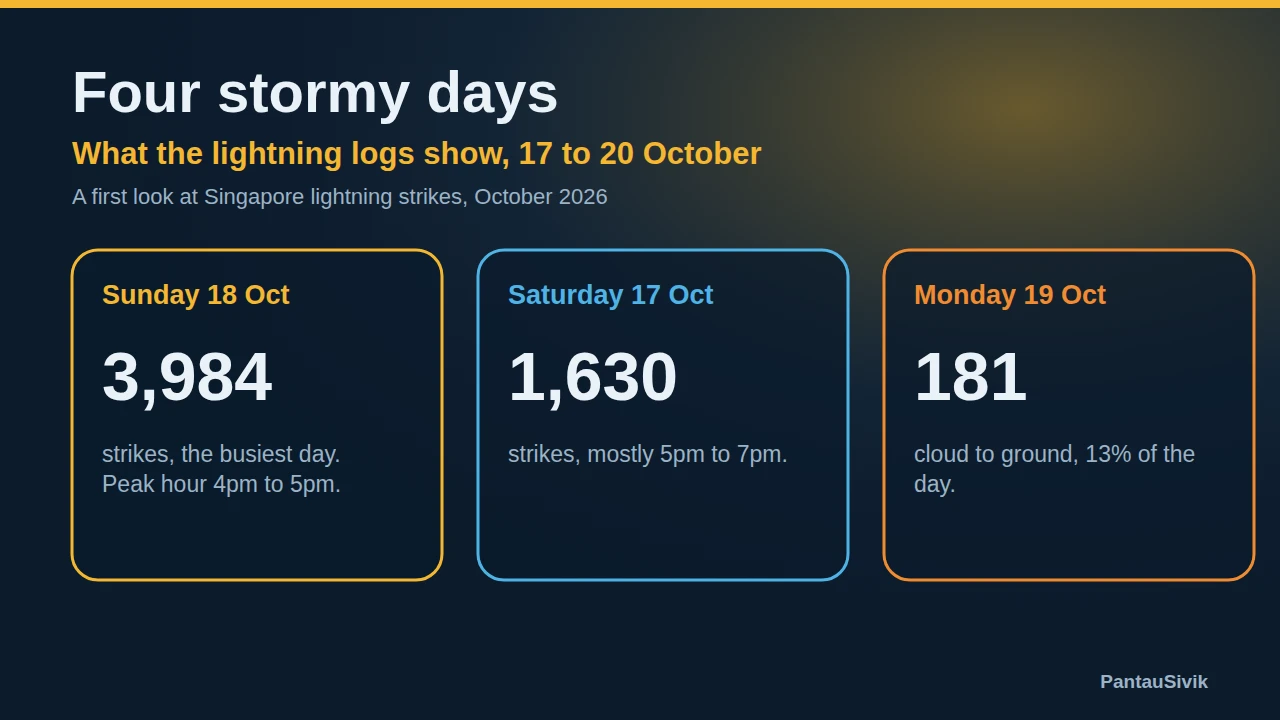
Thunderstorms are most likely in the afternoon and early evening, so the same outing can feel completely different at 10 am and 4 pm. Over four stormy days in October 2026, PantauSivik recorded 8,349 lightning strikes around Singapore, and we looked at when and where they fell in our first look at the lightning data. A storm can sit over one part of the island and leave another dry, which is why an alert for your area is more useful than a general forecast for Singapore.
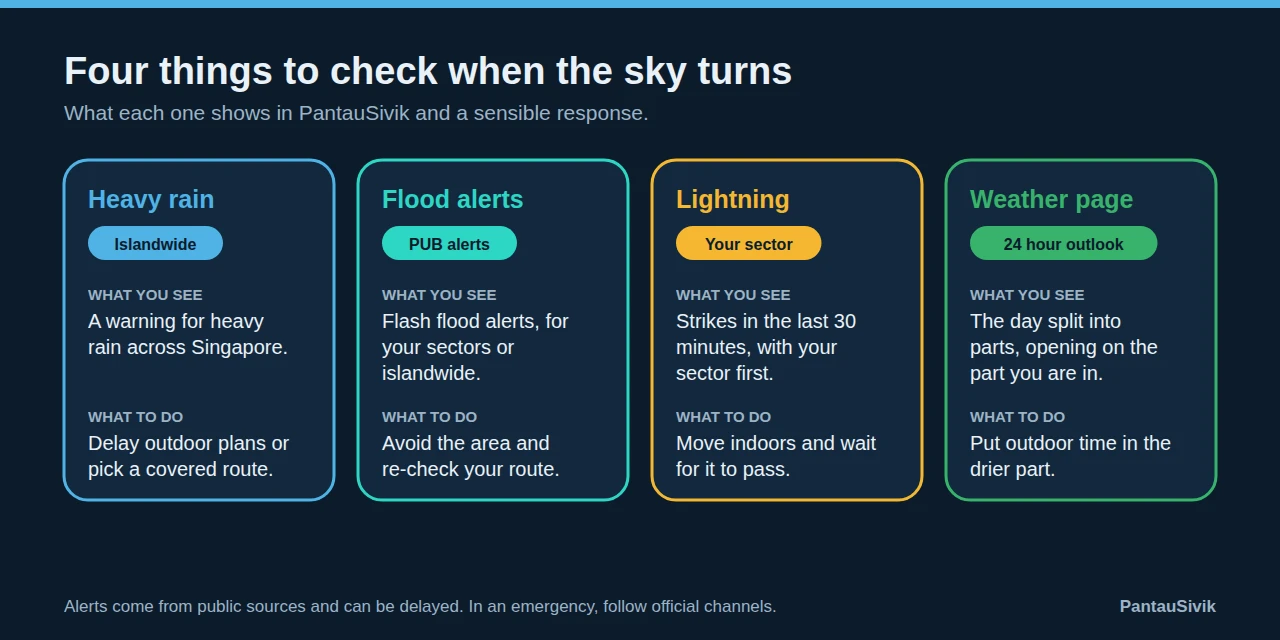
The four things to check
1. The Weather page
Open Weather and allow location. The page picks the area nearest to you. It shows current conditions, a 24 hour outlook split into parts of the day that opens on the part you are in, and lightning with its distance and direction from you. Check it before you leave and again if you will be out for hours. The data comes from public NEA sources. Our Weather, PSI and UV guide explains each reading.
2. Lightning
The Alerts page lightning card shows strikes in the last 30 minutes across Singapore, with a line for each of your sectors, and lightning notifications name your sector first. If you are outdoors and you see or hear a storm, the usual advice is to go indoors and wait for it to pass. With the app closed, you receive at most one lightning notification every 10 minutes, and each one expires after 10 minutes so an old alert does not reach you later.
3. Heavy rain
Heavy rain alerts apply to the whole of Singapore, so the choice is simply Off or Islandwide. After heavy rain, the Alerts card shows "Heavy rain has eased" for 30 minutes. It is a good moment to decide whether to head out or wait a little longer.
4. Flood alerts
Flood alerts come from PUB flash flood alerts and can be set to My sectors or Islandwide. If you get one for the area you are in or heading to, avoid the area and check your route again. Water can rise quickly in low lying places, and a different route may be quicker than waiting.
A simple plan for a rainy day
- Pick a morning outdoor plan and an afternoon indoor plan. Museums, galleries, malls and covered food courts are all easy to find in Singapore.
- Use the underground and sheltered links. Many MRT stations connect to malls and sheltered walkways, so you can often travel most of the way without getting wet. Open the Trip Planner to compare routes, and see our Trip Planner guide.
- Carry a compact umbrella or a light rain jacket. Showers can start quickly, and it is warm enough that you will dry soon.
- Protect your phone. A zip bag or a waterproof pouch is enough.
- Check again before you leave a shelter. The lightning card tells you whether strikes are still near you.
What to pack for a wet trip
You do not need much. A compact umbrella or a light rain jacket, shoes that dry quickly, a small waterproof pouch for your phone and passport, and a spare top if you will be out for the day. Cotton can stay damp in the humidity, so lighter, quick drying fabrics are more comfortable. Sandals with good grip are handy, because wet tiles and pavements can be slippery. If you plan a day outdoors in December, add a thin layer for air conditioned malls and trains, which can feel cold after the rain.
How to set up your alerts as a visitor
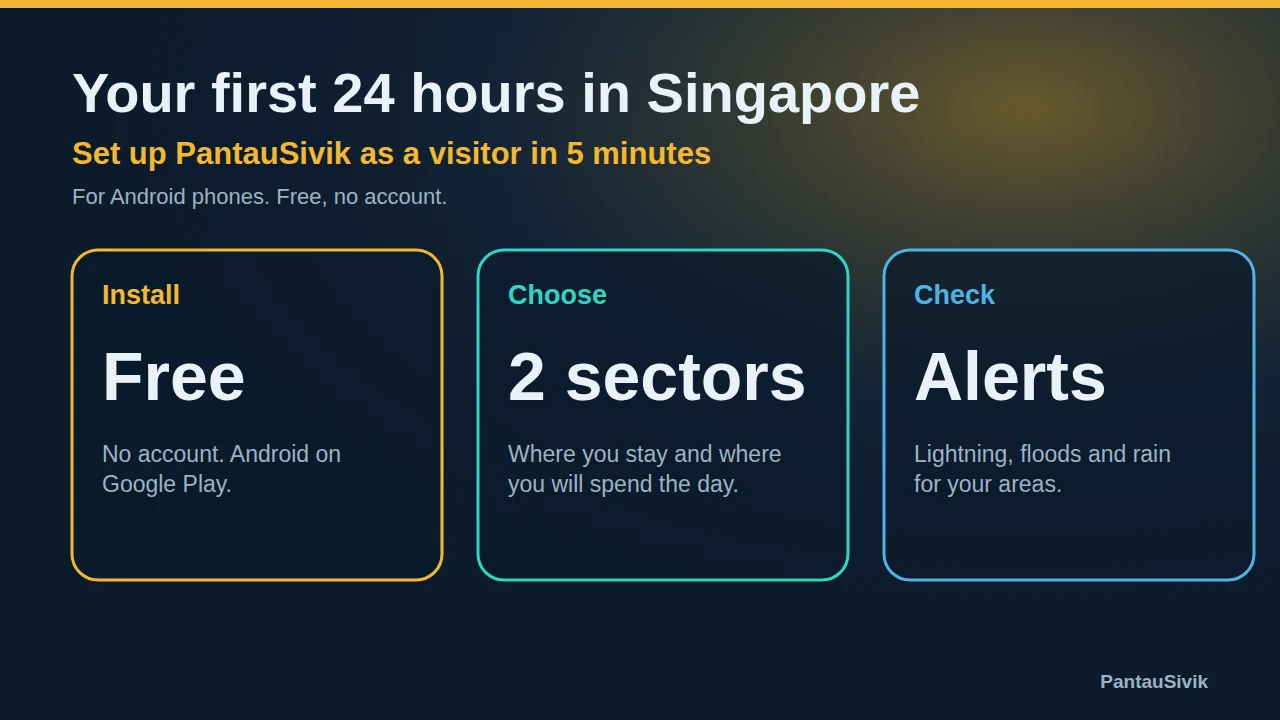
Open Settings, then Notifications, and pick up to 4 of the 47 NEA sectors under My sectors: the area where you stay and the areas you will visit. Set Lightning and Flood alerts to My sectors, and leave Heavy rain on Islandwide. Our first 24 hours guide walks through it, and our full alerts how to explains every setting.
Plan by type of outing
- Beaches, Sentosa and parks. These are the most exposed places when lightning is near, and shelter can be a walk away. Go early, check the lightning card before you set out, and have a covered fallback.
- Food. Hawker centres and food courts are covered, and they are a good place to wait out a shower with a meal.
- Viewpoints and rooftops. Views are usually best when the air is clear, and storms can close or empty outdoor decks. Check the Weather page before you pay for a timed ticket.
- Museums, malls and indoor attractions. Keep one in mind near wherever you are heading, so a change of plan takes minutes rather than an hour of searching.
- Getting around. Trains and many bus interchanges are sheltered. Heavy rain and storms can slow roads, so allow extra time if you are taking a taxi or a ride hailing car.
If you are caught outside
- Move to the nearest covered, enclosed place, such as a station, a mall or a covered walkway.
- Open the Alerts page and look at the lightning card to see whether strikes are close to your sector.
- Wait until the strikes have moved away, then check Weather before you set off again.
- If a flood alert is active for your area, pick a different route and avoid low lying roads and underpasses.
What this guide cannot do
- PantauSivik is on Android only for now, and the app is in English.
- Alerts come from public sources and appear after those sources publish them, so delays are possible.
- It does not replace official warnings. In an emergency, follow official channels and instructions.
Common questions
Does it rain all day in Singapore?
Not usually. Rain is often a heavy shower or a thunderstorm that passes in a short time, and the sun can return afterwards. In the early phase of the Northeast Monsoon, from December to early January, NEA says the rain can be steady and widespread, so a whole wet day is more likely then.
When is the wettest time to visit?
NEA describes October to November as generally wetter, with afternoon and early evening thunderstorms, and December to early January as a wet phase with steady, widespread rain. Late January to early March is windier and drier.
What should I do when I hear thunder?
Go indoors and wait for the storm to pass. Avoid open areas, tall trees and the water. PantauSivik lightning alerts name your sector first, and the Weather page shows the distance and direction of recent strikes.
Can I use PantauSivik if I am only visiting?
Yes. It is free, needs no account and works for Singapore. It is on Google Play for Android only for now, and the app is in English. Our first 24 hours guide shows the setup.
Sources: NEA climate of Singapore; PantauSivik app records for lightning strikes from 17 to 20 October 2026. Weather varies from day to day. Check the forecast before you go.
Information in PantauSivik comes from public sources and is there to help you plan. In an emergency, follow official channels. PantauSivik is independent and not affiliated with any government agency.
See also: Your first 24 hours in Singapore, Four stormy days of lightning, Does rain clear the haze?, Weather, PSI and UV guide, Public Alerts guide, How to set up alerts for home and work, Year end school holidays checklist, 24 October lightning storm.