Home / Blog / Environment
Heat stress in Singapore: how WBGT is worked out, what Moderate and High mean, and when our alerts fire
The temperature on your phone says 32 °C. Is that hot, or is it heat stress? In Singapore the two are not the same thing, and the gap matters if you work, run or play outdoors. Heat stress is measured with a number called WBGT, which folds humidity, sun and air temperature into one reading. This post explains how it is worked out, what counts as Moderate and High, what heat does to the body, and when a PantauSivik heat alert fires. We also counted our own alerts from 31 October to 26 November.
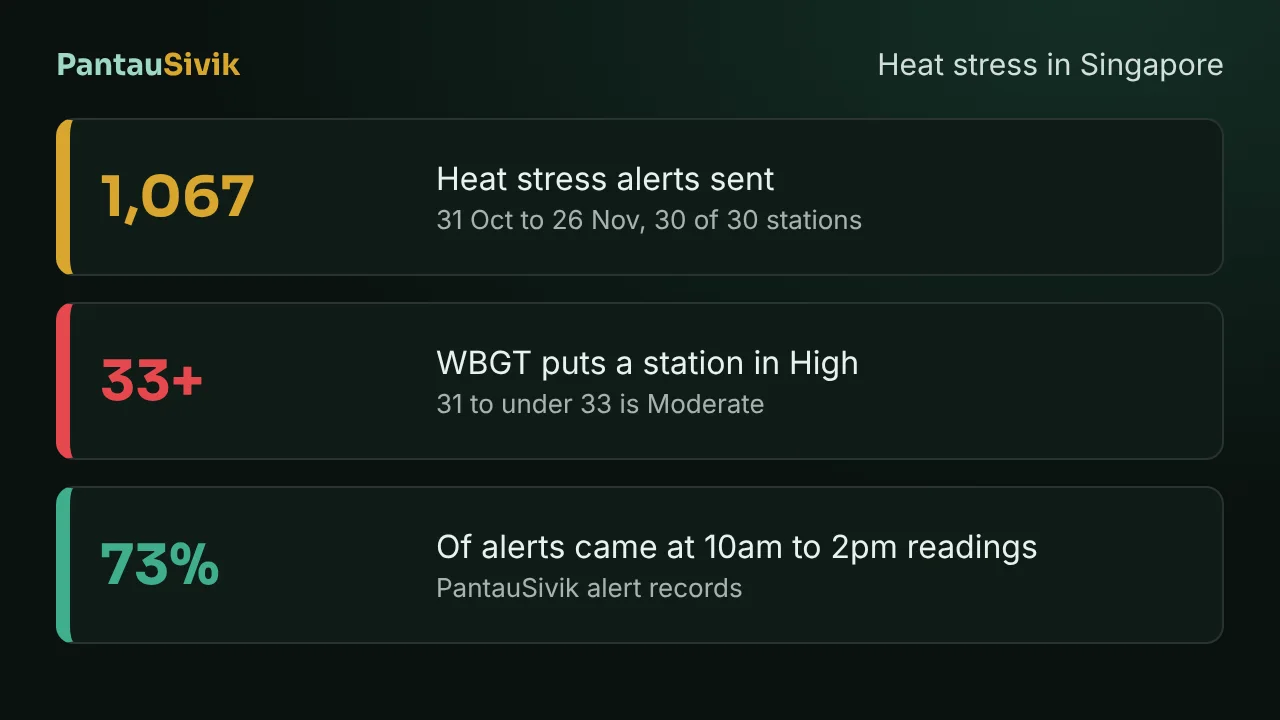
In short: WBGT is 70% natural wet bulb temperature, 20% globe temperature and 10% air temperature. Below 31 is Low, 31 to under 33 is Moderate, and 33 and above is High. A PantauSivik alert fires when a station rises into Moderate or High. From 31 October to 26 November we sent 1,067 alerts: 1,006 Moderate and 61 High. 73% came with readings from 10am to 2pm.
How WBGT is calculated
WBGT stands for wet bulb globe temperature. Singapore's Ministry of Sustainability and the Environment (MSE) gives the outdoor formula in its heat stress guidance:
WBGT = 0.7 × Tnwb + 0.2 × Tg + 0.1 × Td
- Tnwb is the natural wet bulb temperature. A thermometer wrapped in a wet wick sits in the open air. Evaporation cools it, and it cools less when the air is humid. This is why humidity carries 70% of the weight.
- Tg is the black globe temperature. A thermometer inside a small black sphere soaks up radiation from the sun and the ground. It is the sun term.
- Td is the plain air temperature in the shade, the figure a weather app usually shows.
Air temperature gets the smallest weight, which is why it is a poor guide on its own. In our own readings, one afternoon with a 32 °C air temperature gave a WBGT of 30.6, and another gave 32.3. The first sat in Low and the second in Moderate, on the same air temperature. The difference was humidity and sun.
Singapore reports WBGT as a 15 minute average. NEA runs a network of sensors across the island, and the 30 stations in our data each report their own reading. WBGT is a measure of heat load on the body, not of how hot the day feels, so it is not the same as the "feels like" figure in a weather app.
What counts as heat stress
The bands we use in the app are the ones MOM uses for outdoor work:
- Low: below 31.
- Moderate: 31 to under 33.
- High: 33 and above.
The app's heat gauge runs from 24 to 36 and refreshes every 5 minutes. We mark 31 and 33 on it, so you can see how close a station is to the next band. NEA also counts "heat stress days" for its climate reports, and it defines one as a day with at least one hourly WBGT reading of 33 or more.
We could not confirm from an official page the numeric bands behind the public heat advisory that NEA and MSS issue. So we do not quote them here. For the public advisory, use the myENV app or the NEA website.
What heat stress does to your body
Your body cools itself by sweating. When the air is humid, sweat does not evaporate well, so you cool less, and your core temperature can climb. The health information from the National University Hospital (NUH) and HealthXchange describes a ladder of problems:
- Heat cramps: painful muscle spasms, often after heavy sweating.
- Heat exhaustion: heavy sweating, tiredness, headache, dizziness, nausea, a fast pulse and cool, clammy skin. Move to a cool place, loosen clothing and sip water.
- Heat stroke: a medical emergency. The core temperature goes up to about 40 °C or higher, and the person may become confused, drowsy or unconscious. Call 995.
Some people are at higher risk: older adults, young children, people with heart, kidney or lung conditions, people who have been sick recently, and anyone working or exercising hard outdoors. Alcohol and some medicines make it worse. The hours from 11am to 3pm are usually named as the riskiest window, which matches what we see below.
This is general information and not medical advice. If you or someone near you shows signs of heat stroke, do not wait for a reading to change. Get help.
The environmental side
Singapore is getting warmer. NEA and MSS reported that 2024 was the warmest year on record here, with a mean temperature of 28.4 °C, and that the long run warming trend is about 0.24 °C per decade. They counted 21 heat stress days in 2024, against 37 in 2023. One year of counts is a weak guide, so we would not read a trend into the drop. The direction of the average temperature is the part to take seriously.
Dense building, paved ground and little shade add to the load in the city, a pattern often called the urban heat island effect. That is one reason a reading at one station can differ from the next. Our stations did not all behave alike, as the numbers below show.
When our heat alerts fire
PantauSivik checks each station's WBGT reading and sends an alert when the level rises into Moderate or High. It does not send a notice when a reading falls, and it does not repeat for a station that stays in the same band. There is a 30 minute wait before the same station can push again. You get a message for your own sector, using the nearest station, plus one islandwide push for the worst station at that moment.
The text reads like this: "Moderate heat stress. Heat stress is Moderate near [station]. Drink water, rest in the shade and limit strenuous outdoor activity." The same wording is used for High, with the level changed. The setup is covered in our every alert explained post.
An alert is a rise across a line, not an hour of heat. Ten alerts can mean ten stations crossing once, or one station crossing back and forth. We count each one as an alert sent.
What our alert records show
From 31 October to 26 November we sent 1,067 distinct heat alerts. Of those, 1,006 were Moderate and 61 were High. All 30 stations crossed into Moderate at least once. We counted each alert once, however many sectors received it.
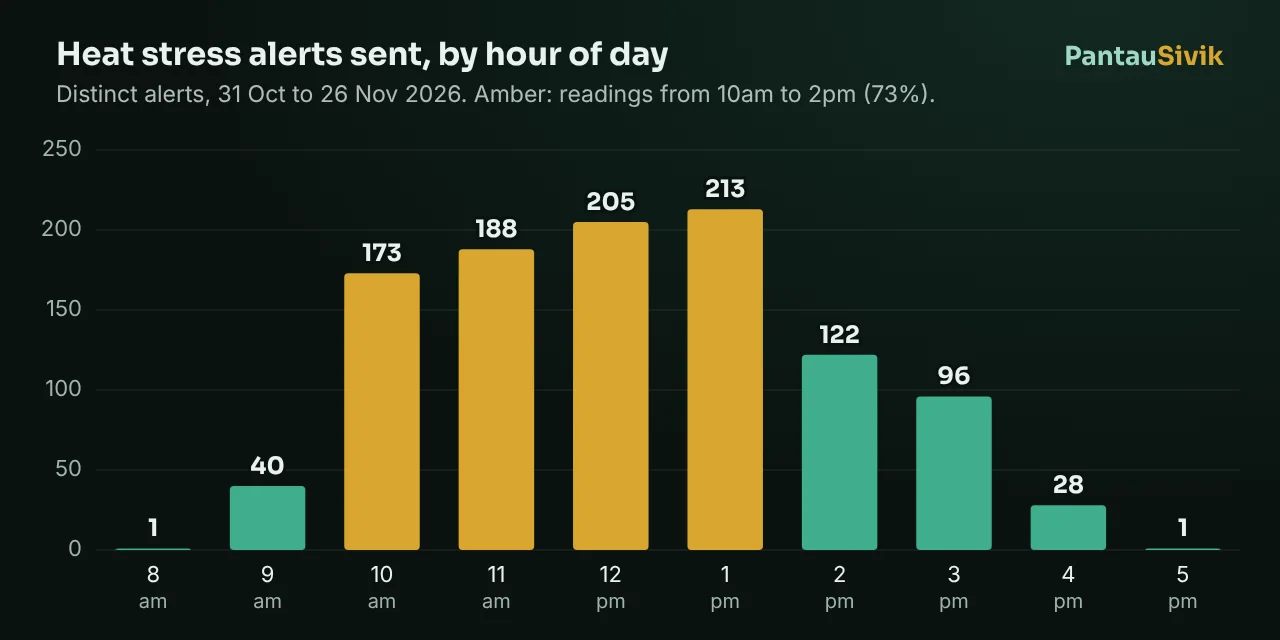
The pattern is tight. The four hours from 10am to 2pm held 779 of the 1,067 alerts, or 73%. Of the 61 High alerts, 49 (80%) came with readings from 11am to 2pm. Almost nothing happened before 9am or after 4pm.
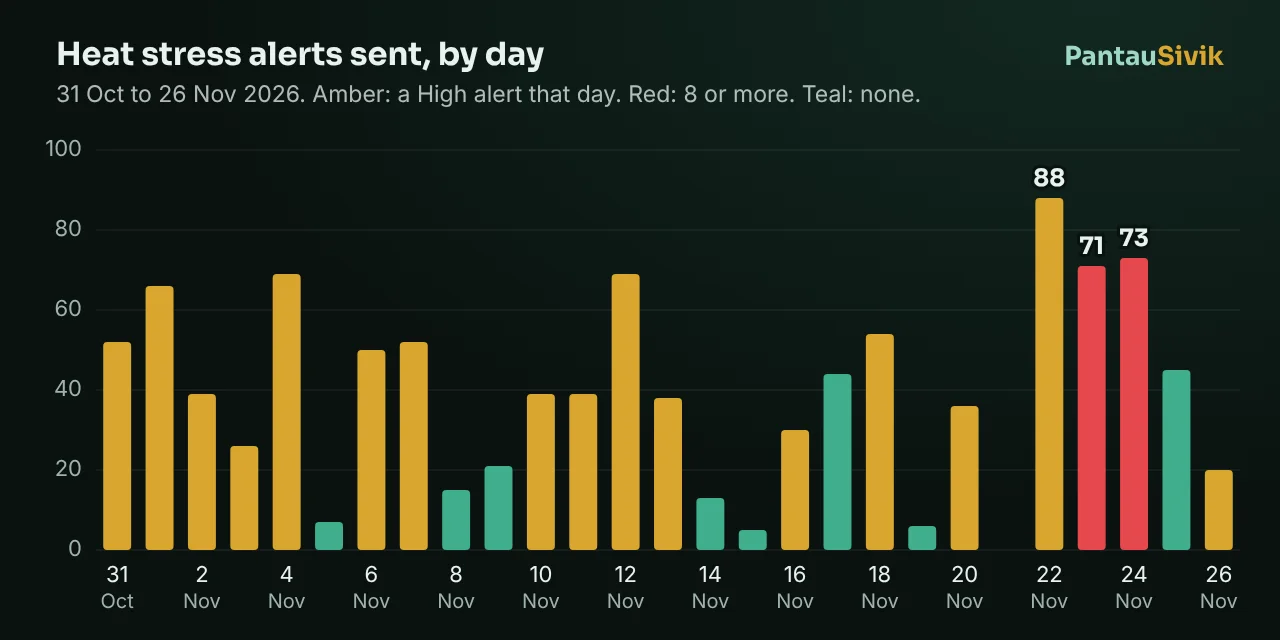
On 18 of the 27 days there was at least one High alert. The worst run was Sunday 22 to Tuesday 24 November, with 88, 71 and 73 alerts, and 27 of the 61 High alerts. On 21 November we sent none at all. The 25th looks busy with 45 Moderate alerts and no High, a reminder that Moderate is common and High is rare.
Stations differed. Mandai Wildlife Reserve sent 74 alerts, 18 of them High, which was the most of any station. We do not know why from our data alone, and we would not guess at the sensor's surroundings.
If you work outdoors
MOM uses the same three bands for outdoor work, and its guidance ties water and rest breaks to them. The exact rest times and rules have been changing, including new mandatory requirements from 1 December 2026, so check the MOM heat stress page for the current figures before you plan a shift. We do not quote break lengths here because we would rather you read the source.
Before you go out
- Open the heat gauge on the Weather page and check the station nearest to you, not the island average.
- Plan hard exercise outside the 10am to 3pm window if you can.
- Carry water, take breaks in the shade, and wear light, loose clothing.
- Turn on Heat for My sectors, so the alert reaches you for home and work. Our setup guide shows how.
- Check on older neighbours and children. They feel it later than you do.
What this does not tell you
- These are our alert counts from public NEA readings, not official figures. We count rises across a band, not hours spent in heat.
- The records cover 27 days in one wet and humid stretch. They say nothing about the hot months of the year.
- Our alerts follow 30 stations, so a place far from a station may feel different.
- The numeric bands of the public NEA and MSS advisory were not confirmed from an official page, so we have not used them.
- The health information is general. It is not medical advice.
Common questions
How is heat stress measured in Singapore?
With the wet bulb globe temperature (WBGT), which combines natural wet bulb temperature (70%), black globe temperature (20%) and shade air temperature (10%). It is reported as a 15 minute average from sensor stations across the island.
What WBGT counts as heat stress?
For outdoor work and in the PantauSivik app, below 31 is Low, 31 to under 33 is Moderate, and 33 and above is High. NEA counts a heat stress day as one with at least one hourly reading of 33 or more.
Why is WBGT different from the temperature on my phone?
Air temperature is only 10% of the formula. Humidity and sun carry most of the weight, so the same 32 °C can give a WBGT in Low on one day and Moderate on another.
What are the signs of heat stroke?
Confusion, drowsiness or unconsciousness, a core temperature around 40 °C or higher, and often hot skin. It is an emergency. Call 995. This is general information, not medical advice.
When does a PantauSivik heat alert fire?
When a station rises into Moderate or High. We do not alert on a fall, and the same station waits 30 minutes before it can push again. You get one for your sector and one islandwide push for the worst station.
What time of day is the hottest in our data?
From 31 October to 26 November, 73% of our 1,067 alerts came with readings from 10am to 2pm, and about 80% of the 61 High alerts came from 11am to 2pm.
Sources: MSE, heat stress guidance and WBGT formula (July 2023), mse.gov.sg. MOM, heat stress guidance and FAQ. NUH and HealthXchange, heat illness information. NEA and MSS, climate of Singapore 2024 release. Alert counts are PantauSivik's own, from NEA WBGT readings, 31 October to 26 November 2026, in Singapore time.
Information in PantauSivik comes from public sources and is there to help you plan. In an emergency, follow official channels. PantauSivik is independent and not affiliated with any government agency.
See also: App guide: weather, PSI and UV, App guide: public alerts, Set up sector alerts.