Home / Blog / Environment
Lightning in Singapore: what an alert means, how long to wait and what to do
Your phone says lightning has been detected. What do you do? A PantauSivik alert tells you where and roughly when. It does not tell you what to do, and we are not the right source for that. The Meteorological Service Singapore (MSS) is. So this post sets out how our alert works, what MSS advises, and what 36 days of our own lightning counts say about when strikes happen. We have already written several data posts on lightning. This one is about the moment you get the alert. All times are Singapore time.
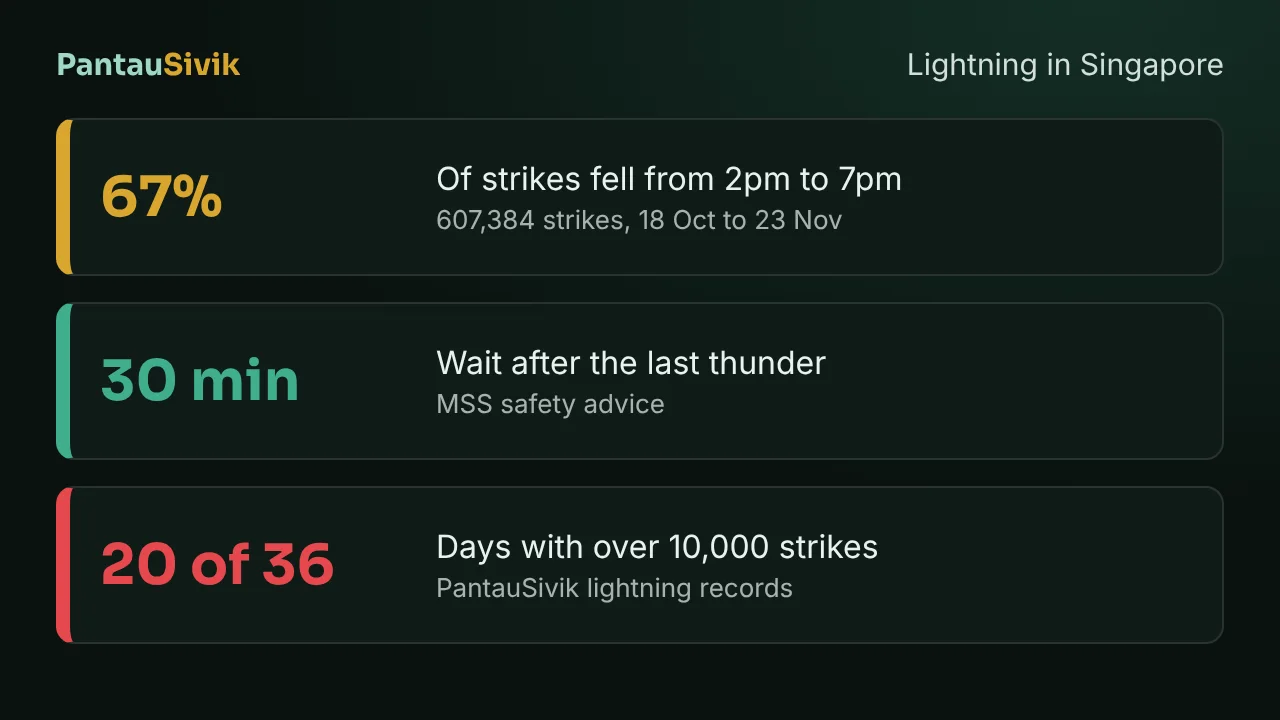
In short: a PantauSivik lightning alert names your sector and says lightning was detected in the last 5 minutes. MSS advises going into a building or a car, staying out of water, and waiting at least 30 minutes after the last thunder before going back outside. In our records from 18 October to 23 November, 67% of strikes fell between 2pm and 7pm. One night storm on 14 November shows it is not only an afternoon thing.
How a PantauSivik lightning alert works
Lightning alerts follow your sectors. A sector is one of the 47 NEA sectors, and you pick yours under My sectors. The alert names your sector first, so you can tell whether the strikes are near home or near your office. The text says lightning has been detected within the last 5 minutes.
Two places in the app show the same picture in different ways. The Home Alerts card counts strikes within 5 km of you. The lightning card on the Alerts page shows strikes across Singapore in the last 30 minutes, with a line for each of your sectors.
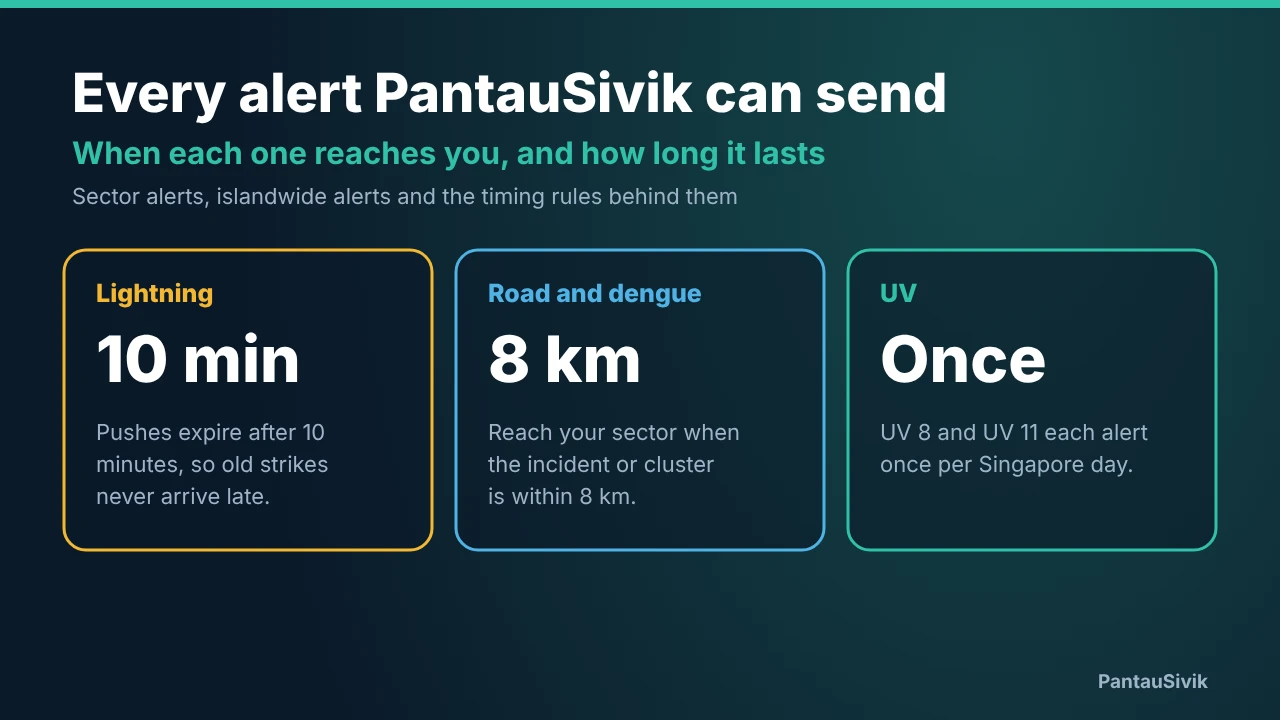
The limits matter. With the app closed, we send at most one lightning notification every 10 minutes, and each one expires after 10 minutes. If your phone was off, it does not catch up on old strikes. So a quiet phone does not mean the storm has passed. It may only mean the last alert has expired. The same rules are in our alerts explained post.
PantauSivik is not an official alert. The NEA and MSS run their own lightning information service. According to Mothership's report of 10 July 2026, its default alert fires when cloud to ground lightning is detected, or thundery showers are forecast, within 6 km of a location over the next two hours, and it sends a follow up when no lightning has been seen in the watch area for 30 minutes. That is a different radius and different logic from ours, so treat the two as separate tools.
What MSS says to do
MSS's lightning safety page, "How Can I Protect Myself?", gives short advice:
- Wait at least 30 minutes after the last thunder you hear before going back to outdoor activities.
- Go into a building or a car. Do not shelter under tall trees or small structures such as tents.
- Stay out of and away from water, such as the sea or a swimming pool.
- Do not hold metal objects such as golf clubs, and limit your use of electrical appliances.
The same page says lightning can strike some distance from a thunderstorm, so it can happen when it is not raining. For current conditions it points to the myENV app, the MSS lightning website and the weather hotline, 6542 7788.
Mothership's July 2026 report adds what MSS said after a paddleboarder died at Pasir Ris Beach on 5 July. A strike was detected there while the main thundercloud was still a few kilometres away. MSS said open areas such as fields, beaches and parks are generally at higher risk because they are exposed, and tall structures may be more likely to be struck.
If you work, run, drive or spend time outdoors
We did not find separate official rules for each group, and we will not invent them. The advice above applies to everyone. Here is how it reads in practice:
- Outdoor work. Your employer may have its own lightning procedure. Follow it. MSS's 30 minute rule is the general reference.
- Running and parks. Open ground is the exposed place MSS names. Trees and tents are not shelter.
- Beaches and water. MSS says to stay out of the sea and pools. Our beach post covers NEA's weekly water quality bands and tide times for the school holidays.
- Driving. MSS names a car as shelter. Storm evenings are also slow on the roads. The 16 November storm gave us the slowest evening on the PIE in our records, which our last week of term post covers.
When strikes happen in our records
We count lightning strikes across Singapore by hour from public detection data. From 18 October to 23 November there are 36 full days. We leave out 3 November because it is incomplete. Those days hold 607,384 strikes. Of those, 17,885, about 2.9%, were cloud to ground and the rest were cloud to cloud.
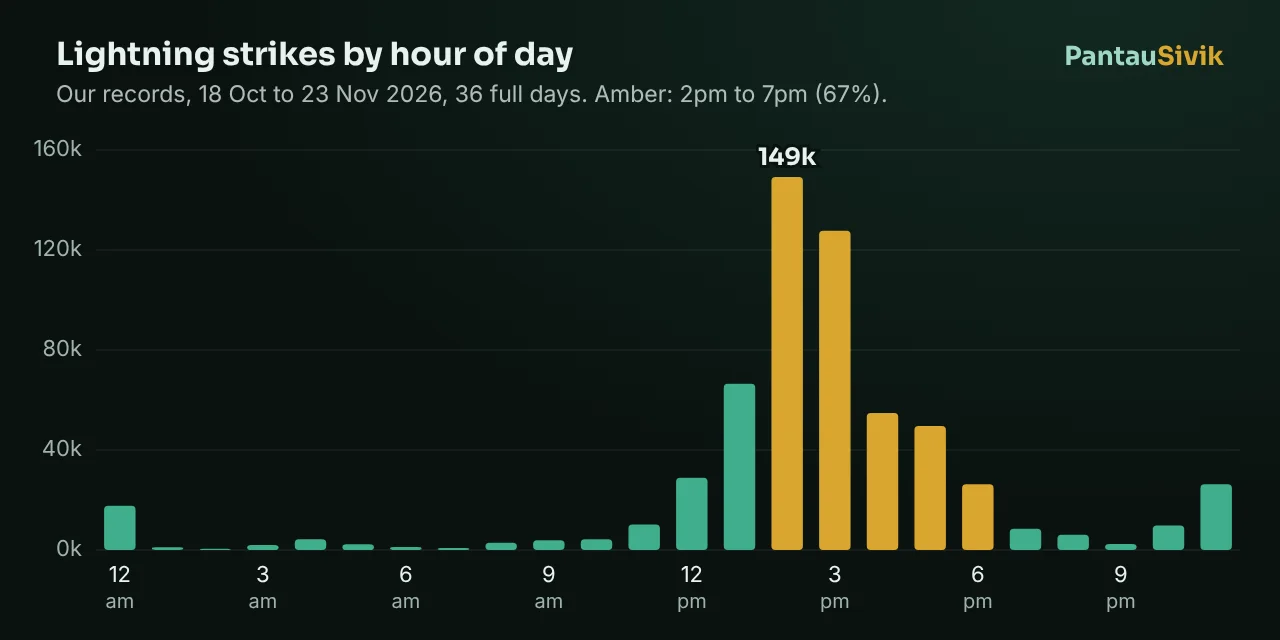
The hour from 2pm alone had 149,192 strikes, about 25% of the total. The five hours from 2pm to 7pm had 407,609, or 67%, and the eight hours from 12pm to 8pm had 84%. Twenty of the 36 days passed 10,000 strikes, and those 20 days hold 92% of all strikes. On a big day the pattern is the same: the 2pm to 7pm window held 67% of those days' strikes too.
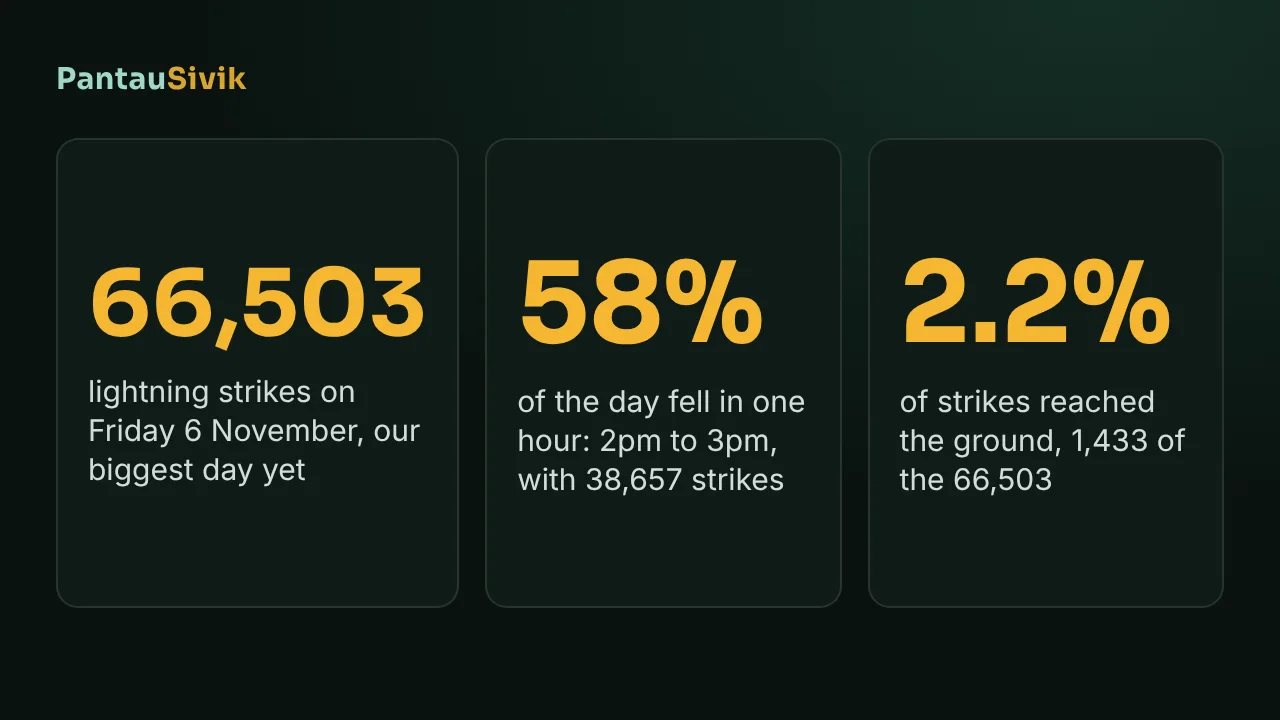
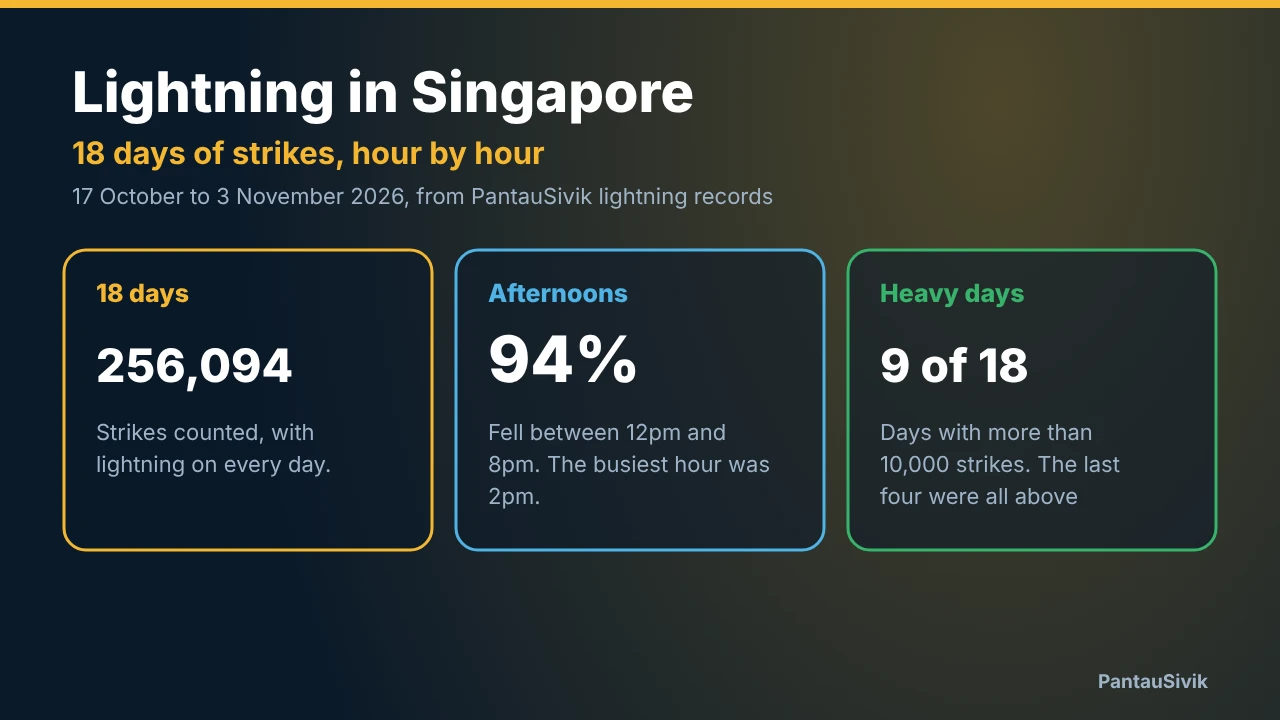
It is not only an afternoon pattern. On Saturday 14 November, 25,795 strikes fell in the hour from 11pm, and another 17,590 in the hour from midnight on the 15th. That one night storm is part of why the 12pm to 8pm share is 84% here, against 94% in our 17 October to 3 November post. The longer window and the different start day also change it. The big single days are in our posts on 24 October and 6 November, and the figures here agree with them: 55,013 and 66,503 strikes.
One day in detail: Monday 16 November
On 16 November we counted 24,527 strikes, and 24,284 of them fell from 4pm to 7pm. Our feed recorded 273 lightning alerts that day, reaching all 47 sectors, the first at 2:56pm and the last at 6:25pm.
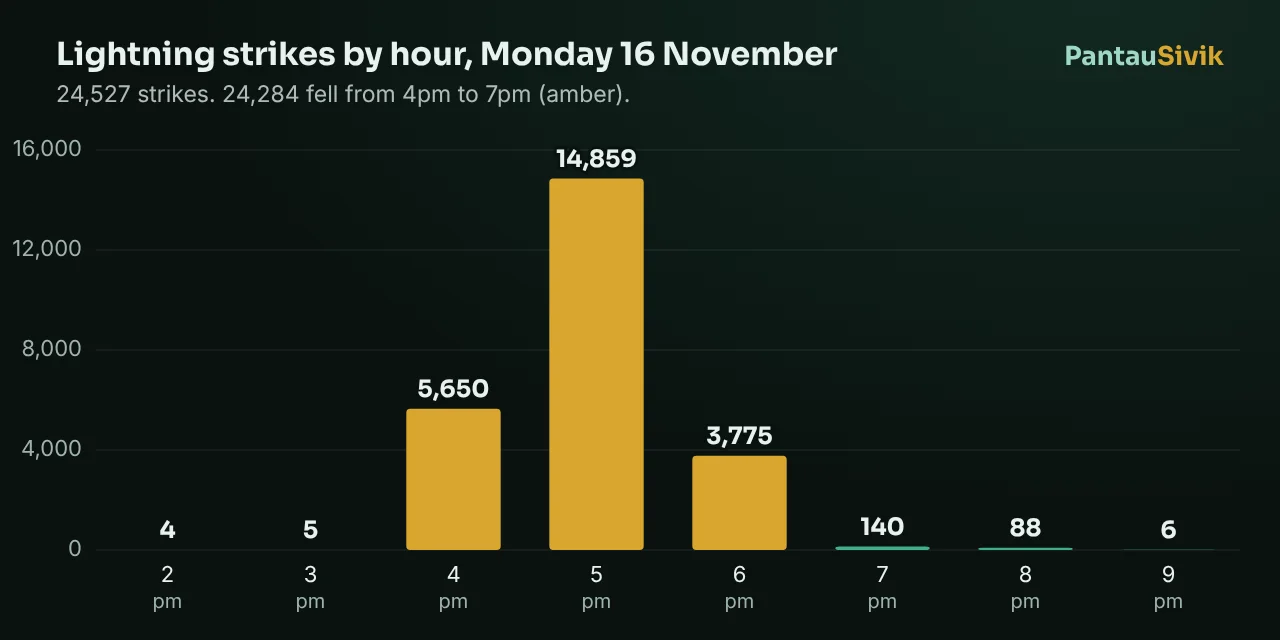
The count fell from 3,775 in the hour from 6pm to 140 in the hour from 7pm, a drop of 96%. It did not reach zero for two more hours: 88 in the hour from 8pm and 6 from 9pm. We only have hourly counts, so we cannot show the gaps between strikes and this is not a test of the 30 minute rule. It is a reminder that a storm's last strikes arrive after its peak.
Before you go out
- Open the lightning card on the Alerts page. It shows strikes in the last 30 minutes, with a line for each of your sectors.
- Set Lightning to My sectors for home and work. Our setup guide shows how.
- Keep notifications on, and remember that each alert expires after 10 minutes.
- In our records the busiest window is 2pm to 7pm, so plan open air activities around it. Do not rely on it, because of 14 November.
- For the official view, use the myENV app or the MSS lightning website.
What this does not tell you
- These are our counts of public detection data, not official figures. They count strikes, not storms and not danger to a person.
- The records cover 36 days of one wet stretch, from late October to late November. We cannot say the same pattern holds in other months.
- Only about 2.9% of strikes reached the ground. That does not make a storm safe. MSS says lightning can strike some distance from a thunderstorm.
- Counts are hourly, so we cannot show how long the gaps between strikes were.
- The MSS advice is from its safety page as we read it on 25 November 2026. The 6 km alert details and the Pasir Ris account come from one news report. Check MSS for anything newer.
- We found no separate official guidance for workers, runners or drivers.
Common questions
What does a PantauSivik lightning alert mean?
It names one of your sectors and says lightning was detected within the last 5 minutes. It is a heads up, not an official warning and not an all clear. With the app closed we send at most one every 10 minutes, and each expires after 10 minutes.
How long should I wait after the last thunder?
MSS advises waiting at least 30 minutes after the last thunder you hear before going back to outdoor activities. It also advises going into a building or a car and staying out of water.
Can lightning strike when it is not raining?
Yes. MSS says lightning can strike some distance from a thunderstorm, so it can happen when it is not raining.
When does lightning happen most in Singapore?
In our records from 18 October to 23 November, 67% of 607,384 strikes fell between 2pm and 7pm, and the hour from 2pm held about 25%. A night storm on 14 and 15 November had 43,385 strikes between 11pm and 1am, so it is not only an afternoon pattern.
How often will PantauSivik send a lightning alert?
With the app closed, at most one lightning notification every 10 minutes. Each lightning push expires after 10 minutes, so a phone that was off does not get a burst of old strikes.
Sources: MSS, How Can I Protect Myself? Lightning, read on 25 November 2026. Mothership, report of 10 July 2026, for the 6 km alert logic and MSS's comments on open areas. Strike counts and alert records are PantauSivik's own, from public lightning detection data, 18 October to 23 November 2026, in Singapore time.
Information in PantauSivik comes from public sources and is there to help you plan. In an emergency, follow official channels. PantauSivik is independent and not affiliated with any government agency.
See also: App guide: public alerts, Set up sector alerts, Beaches and tides in the school holidays, Every alert explained.