Home / Blog / Environment
Dengue in Singapore, November 2026: weekly cases, active clusters and what to do at home
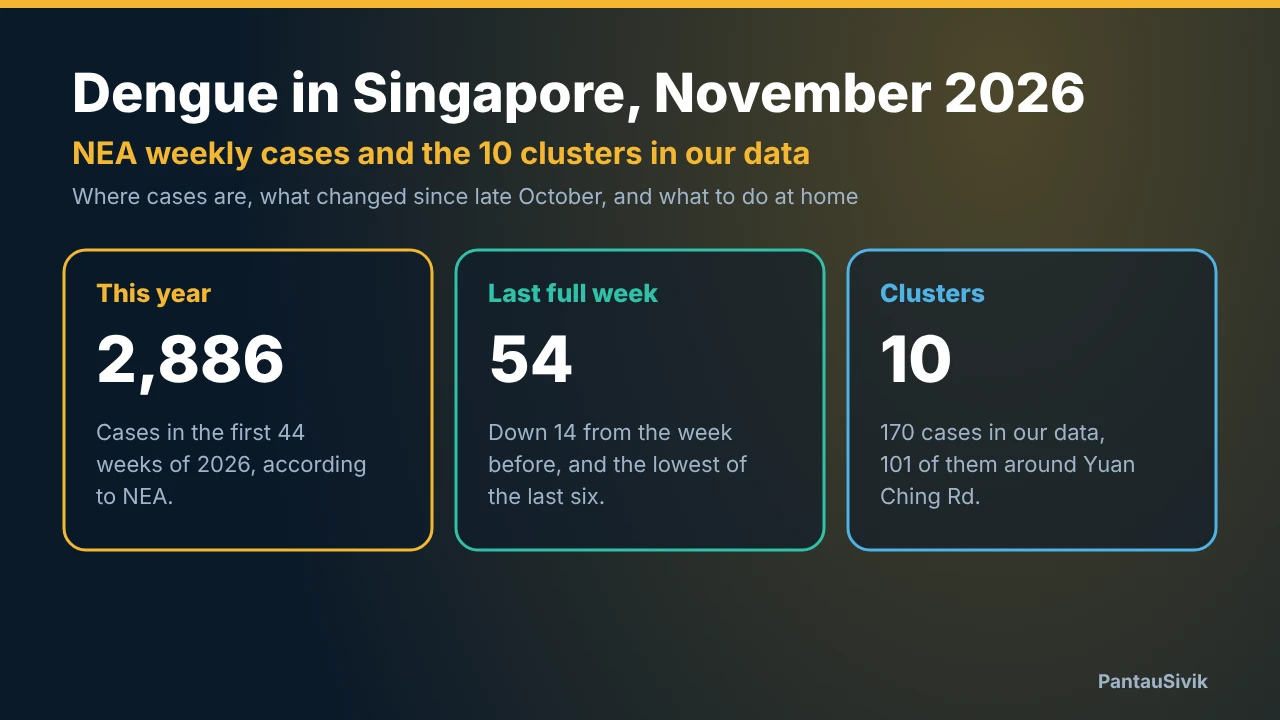
NEA reported 54 dengue cases in the week of 1 to 7 November, the lowest of the last six full weeks. The year to date stands at 2,886 cases. That is the national picture. The local picture is different: 170 cases sit in 10 active clusters in our data, and more than half of them are in one place in Jurong West.
In short: weekly cases have stayed between 54 and 79 since late September, and the latest full week was the lowest of the six. Ten clusters were active on 9 November, with 101 cases around Ho Ching Road, Kang Ching Road, Tah Ching Road and Yuan Ching Road. Three smaller clusters around Lentor add up to 35.

The weekly picture from NEA
NEA publishes dengue cases by epidemiological week. Weeks 39 to 44 ran from 27 September to 7 November, and they had 71, 79, 60, 61, 68 and 54 cases. That averages 65.5 a week. Week 45 had 23 cases by 11 November, but it covers only four days of counting so far.
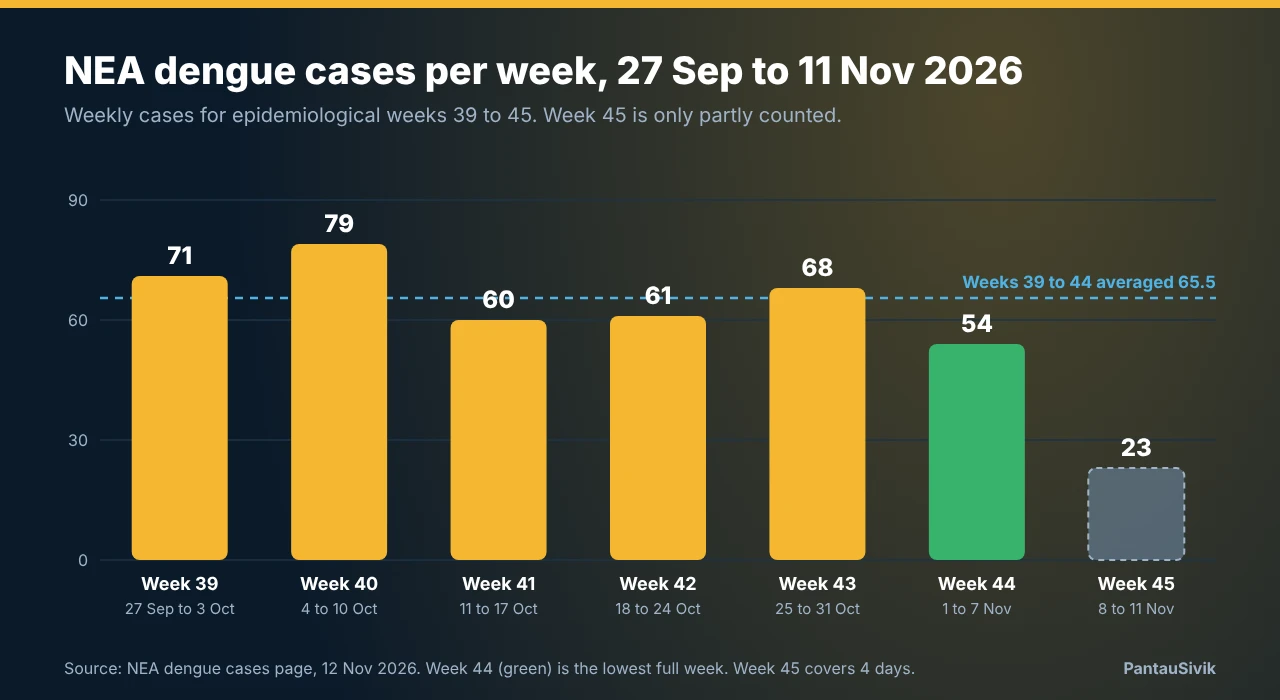
There is no sharp rise or fall in these six weeks. Week 44 is the lowest, 14 below week 43, but one week does not make a trend. NEA's page does not show earlier years, so we cannot say how this compares with 2025 here. NEA is quoted as saying that May to October is the traditional peak season, and this data runs to the end of that window.
Where the clusters are
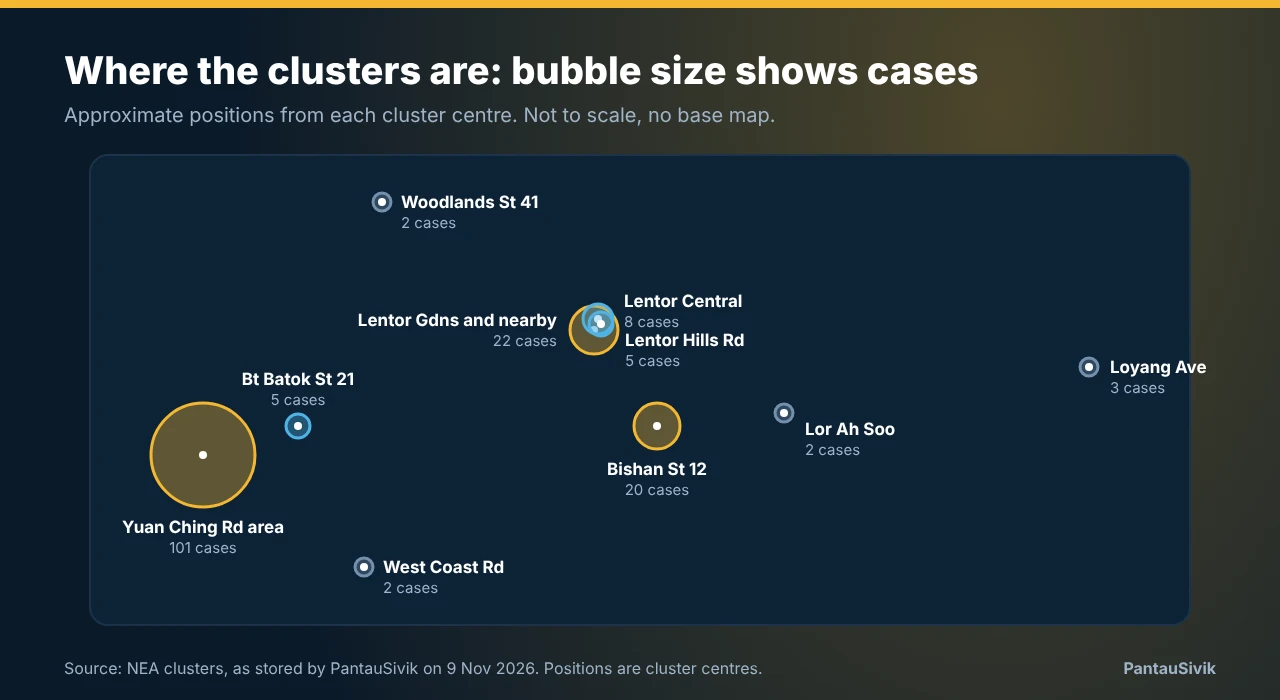
A cluster is an area where dengue cases sit close together in time and place. NEA publishes them, and PantauSivik reads the list and shows them on the Alerts page. On 9 November our data held 10 clusters with 170 cases in total.
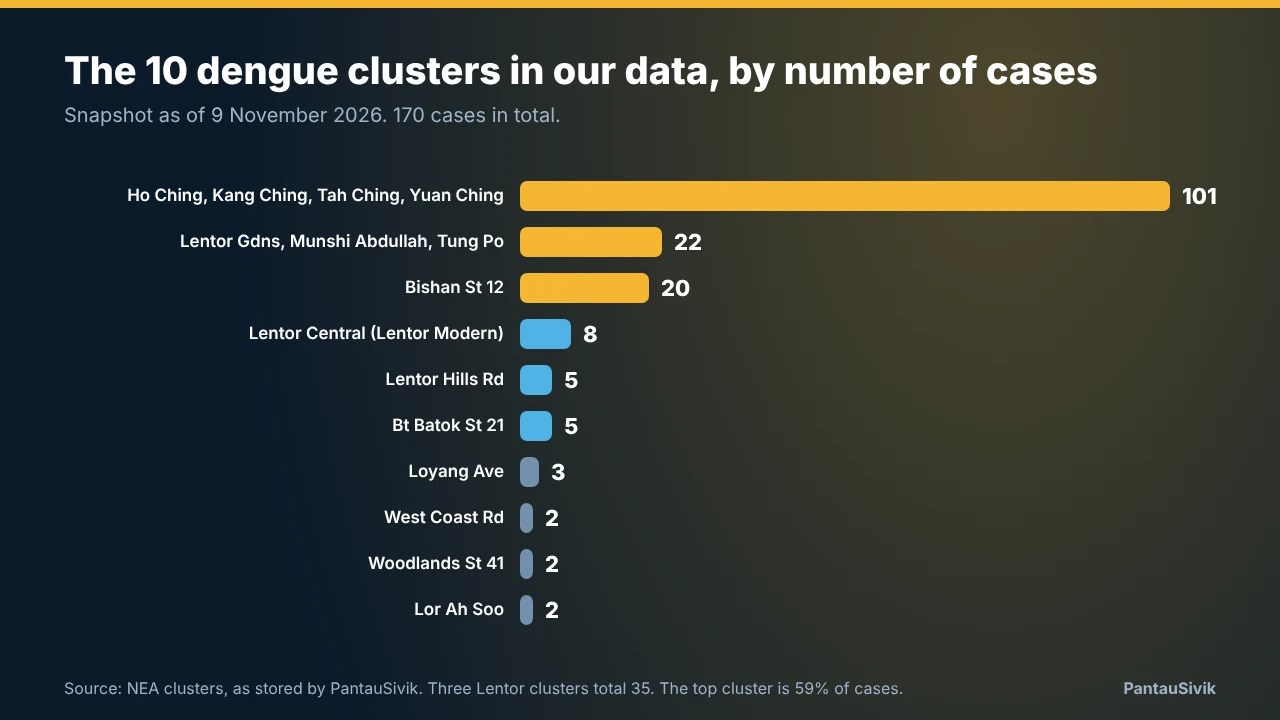
- Ho Ching, Kang Ching, Tah Ching and Yuan Ching Roads, Jurong West: 101 cases. This one cluster is 59% of all cases in active clusters. It covers a long list of blocks and Lakeside Towers. A news report of NEA data for the week ending 24 October put it at about 99, so it has grown slowly since.
- Lentor Gardens, Munshi Abdullah Avenue, Tung Po Avenue and Yio Chu Kang Drive: 22 cases. That report had 15 cases for the Lentor Gardens area, and its name now also includes Yio Chu Kang Drive, so the area has grown as well as the count. Two smaller clusters, Lentor Central (8) and Lentor Hills Road (5), appeared on 30 October. Together the three have 35 cases.
- Bishan Street 12: 20 cases across nine blocks, up from 18 in the same report.
- Five smaller clusters of 2 to 5 cases in Bukit Batok, Loyang, West Coast Road, Woodlands and Lor Ah Soo.
What NEA found at the largest cluster
NEA's records also list the items found with mosquito breeding, grouped by where they were. For the Jurong West cluster, the list under homes includes a dish tray or rack, an overturned plastic stool, a glass jar and a flowerpot plate. In public areas it lists gully traps, closed perimeter drains, service road drains and scupper drains. At construction sites it lists a canvas sheet, a common toilet, a scupper drain and a floor trap.
Most of these are small, ordinary things that hold a little water. That is the point of NEA's weekly checklist.

What to do at home
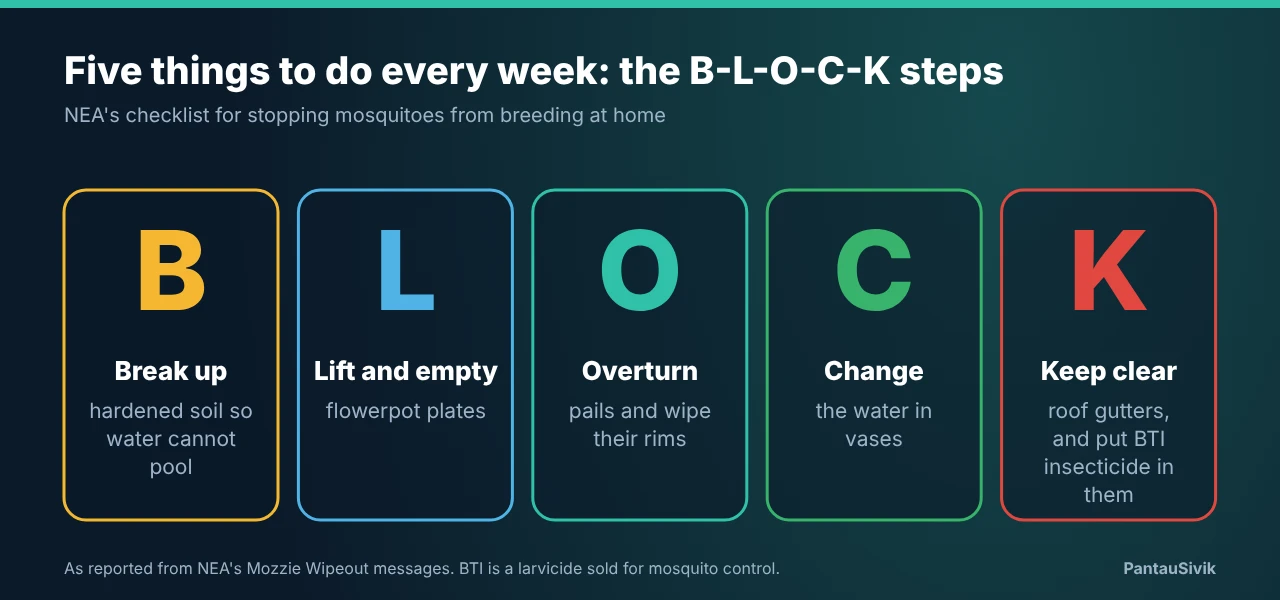
NEA asks households to follow the B-L-O-C-K steps every week: break up hardened soil, lift and empty flowerpot plates, overturn pails and wipe their rims, change the water in vases, and keep roof gutters clear, with BTI insecticide placed in them. The steps take a few minutes. If you get a fever, see a doctor.

Getting dengue alerts near you
- Choose up to 4 sectors. Pick the places where you live, work or study.
- Open More, then Settings, then Notifications, and set Dengue to My sectors.
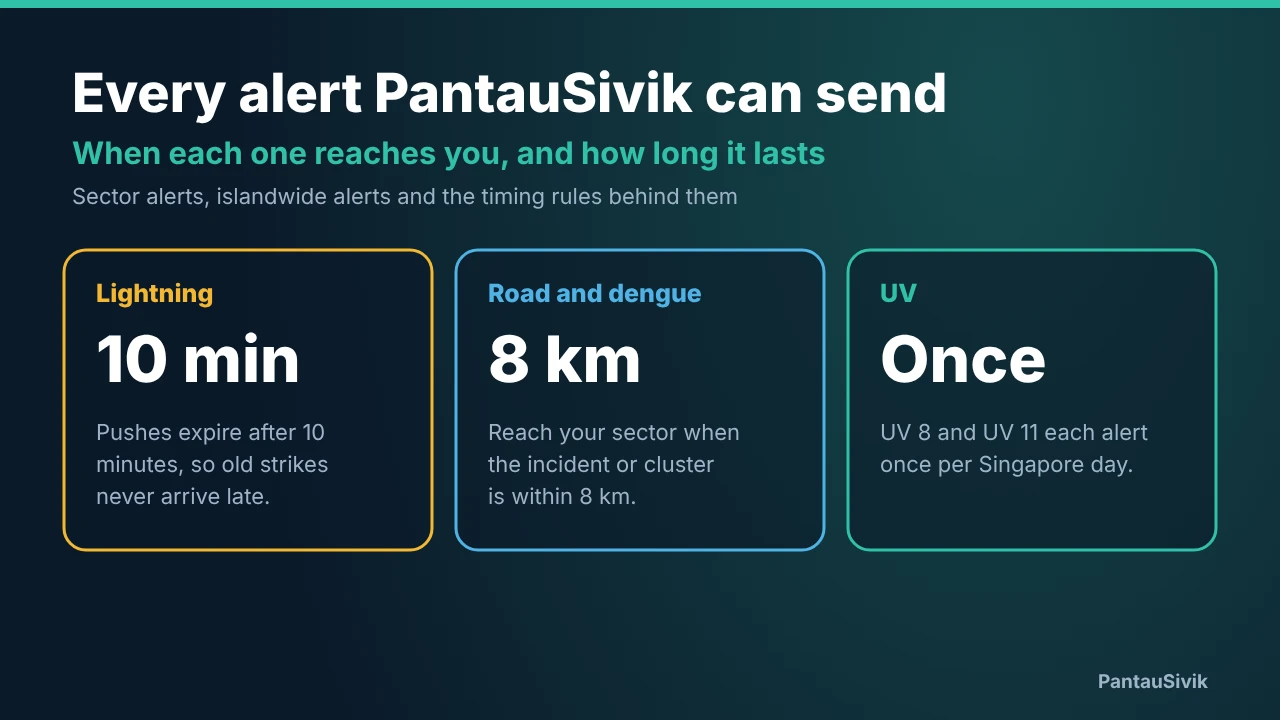
- When a cluster appears within 8 km of a sector, the alert starts with Near and the sector name. An islandwide copy is also sent.
On the Alerts page, dengue sits under Ground hazards. The time shown beside a cluster, such as 2 hours ago, is the last time NEA's data changed for it, not the last time we checked. Since 6 November we only record a cluster again when it changes. Our alerts guide explains the other alert groups and our setup guide walks through choosing sectors.
What this data cannot tell you
- Not every case is in a cluster. The NEA weekly count covers all reported cases. The cluster list covers only those grouped into active clusters, so the two do not add up.
- We only hold the current clusters. Our database keeps clusters since 30 October and drops them when NEA does, so we cannot show a cluster by cluster trend yet.
- Counts are NEA's. A cluster can grow or close at any update. The cases here are as of 9 November.
Sources: NEA dengue cases page, read on 12 November 2026 (weeks 39 to 45, 2,886 cases to week 44). Cluster data from NEA's Dengue Clusters dataset on data.gov.sg, as stored by PantauSivik on 9 November 2026. Earlier cluster counts and the B-L-O-C-K steps as reported by The Independent SG, for the week ending 24 October. This post is not medical advice.
Dengue cluster alerts are one of the alert types counted on the alerts history page, day by day.
Common questions
How many dengue cases are there in Singapore in 2026?
NEA reported 2,886 cases in the first 44 epidemiological weeks of 2026, which end on 7 November. Week 44 had 54 cases, 14 fewer than week 43. Week 45 had 23 cases up to 11 November, with the week still running.
What is a dengue cluster?
NEA draws a cluster around dengue cases that are close together in place and time. PantauSivik shows the clusters NEA publishes, with the number of cases in each. On 9 November our data held 10 clusters and 170 cases.
Which area has the most dengue cases right now?
The cluster around Ho Ching Road, Kang Ching Road, Tah Ching Road and Yuan Ching Road in Jurong West had 101 cases in our 9 November data, which is 59% of all cases in active clusters.
How do I get dengue alerts for my area in PantauSivik?
Choose up to 4 sectors, then set Dengue to My sectors on the Notifications page. You get an alert that starts with Near and your sector when a cluster is within 8 km. An islandwide copy is also sent.
How do I stop mosquitoes from breeding at home?
Follow NEA's B-L-O-C-K steps every week: break up hardened soil, lift and empty flowerpot plates, overturn pails and wipe their rims, change the water in vases, and keep roof gutters clear, with BTI insecticide in them. If you get a fever, see a doctor.
Information in PantauSivik comes from public sources and is there to help you plan. In an emergency, follow official channels. PantauSivik is independent and not affiliated with any government agency.
See also: Every alert PantauSivik can send, How to set up alerts for your home and work, Singapore week in data, 30 October to 5 November, Public Alerts guide.